Overview
📦 GitHub:
rb-amp/rbamp-esp-idf— source, examples, changelog (v1.5.0).
Install:idf.py add-dependency "rbamp/rbamp^1.5"
What rbAmp is
rbAmp is a compact hardware module for precision measurement of AC-mains parameters over the I²C interface. It is built around a Cortex M0+ microcontroller with an integrated isolated analog front end and factory calibration stored in flash.
From an integrator's point of view, the module behaves like a standard
I²C slave: apply power, open the bus with i2c_new_master_bus(),
create a handle with rbamp_new() — and you get ready-to-use values in
physical units through the rbamp_read_*() functions. No master-side
signal processing is required.
What rbAmp measures
| Quantity | Type | Range |
|---|---|---|
| RMS voltage U_rms | float, V | 0…300 V |
| Peak voltage U_peak | float, V | 0…450 V |
| RMS current I_rms | float, A | depends on the selected sensor — see 03_sensor_selection.md |
| Peak current I_peak | float, A | depends on the selected sensor |
| Active power P (signed in RT) | float, W | depends on the selected sensor |
| Power factor PF | float | −1…+1 |
| Mains frequency | uint8, Hz | 45…65 Hz |
| Period-averaged P | float, W | same as P |
The RT active-power value
Pis always signed on every module tier (negative means export to the grid). The behavior of the period-averaged value (avg_p[ch]inrbamp_period_snapshot_t) depends on the module tier — see the "Module tiers" section below and 02_tiers.md.
Connection
The module connects to the master with four wires on the LV side. The mains side is already routed inside the enclosure and is galvanically isolated.
| Wire | Purpose |
|---|---|
VCC |
+5 V (4.5..5.5 V), ~15 mA current, ~25 mA peak. On-board regulator and filtering |
GND |
common with the master (mandatory) |
SDA, SCL |
I²C, 3.3 V logic, 5 V-tolerant. Built-in 4.7 kΩ pull-ups to 3.3 V |
DRDY |
optional, open-drain LOW for ~10 µs every ~200 ms |
The default address is 0x50 (7-bit, changeable in the 0x08..0x77
range), with a recommended speed of 50 kHz on ESP32 (see the section on
retry + sanity discipline below). The cold start until the first valid
measurement takes ~250 ms.
The full rules (bus length, pull-up recommendations on a multi-module bus, wiring diagrams for the various ESP32 targets) are in chapter 04 · Hardware connection.
Module tiers (quick cheat sheet)
In the current firmware (v1.2) only the BASIC tier is implemented — one-directional (consumption-only) metering following the logic of a classic mechanical meter:
| Tier | RT power P |
Per-period accumulator avg_p[ch] |
Component Wh counter |
|---|---|---|---|
| BASIC | signed (negative = export to the grid, visible in real time) | each 200 ms window of the average P is clamped to max(P, 0) before being added to the period accumulator |
monotonic — meters consumption only |
| STANDARD | planned for v1.3+ | planned — a separate export accumulator | planned — bidirectional metering |
| PRO | planned for v1.3+ | planned + diagnostics | planned + additional counters |
Details are in chapter 02 · Module tiers. At the component
level the same rbamp_handle_t handle is used regardless of tier; the
differences show up in the values the module returns.
Bidirectional metering on BASIC:
rbamp_energy_wh(dev, ch)on the BASIC tier reports consumption only. If you need to account for export separately, sample the RT power withrbamp_read_power(dev, 0, &p)at ~5 Hz and split the positive and negative samples into two accumulator variables yourself. See the example in 06_examples.md (the BidirectionalEnergy scenario).
What this component does
Its main job is to hide the protocol exchange and relieve the user
application of the chore of dealing with registers, byte order, and
the post-command settle times. In addition, the component computes
energy (Wh) — the module returns only the period-averaged power, and
the master performs the integration using esp_timer_get_time().
Without the component (direct access via i2c_master_transmit_receive)
// Read U_RMS — collect 4 bytes over 4 transactions
// (SPEC §6 — no auto-increment).
i2c_master_dev_handle_t slave;
i2c_master_bus_add_device(bus, &(i2c_device_config_t){
    .device_address = 0x50, .scl_speed_hz = 50000,
}, &slave);
uint8_t buf[4] = { 0 };
for (int i = 0; i < 4; i++) {
    uint8_t reg = 0x86 + i;
    if (i2c_master_transmit_receive(slave, ®, 1, &buf[i], 1,
                                    /*xfer_timeout_ms=*/100) != ESP_OK) {
        return;   // handle the error
    }
}
float u_rms;
memcpy(&u_rms, buf, sizeof(float));
With the component
float u_rms;
ESP_ERROR_CHECK(rbamp_read_voltage(dev, 0, &u_rms));
Reading a period — without the component
// Latch + 50 ms settle + ready-flag check + assembling the 4 avg_p bytes
uint8_t latch_cmd[2] = { 0x01, 0x27 };   // REG_COMMAND, CMD_LATCH_PERIOD
ESP_ERROR_CHECK(i2c_master_transmit(slave, latch_cmd, 2, /*xfer_timeout_ms=*/100));
int64_t t_latch_us = esp_timer_get_time();
vTaskDelay(pdMS_TO_TICKS(50));   // settle
uint8_t valid_reg = 0x07, valid_byte = 0;
i2c_master_transmit_receive(slave, &valid_reg, 1, &valid_byte, 1, /*xfer_timeout_ms=*/100);
if ((valid_byte & 0x01) == 0) {
    // the snapshot is stale — t_latch_us must STILL be recorded,
    // otherwise the next snapshot will count Wh over two periods
    return;
}
// ...read the 4 avg_p bytes, assemble the float, integrate Wh:
//   double dt_s = (esp_timer_get_time() - t_prev_latch_us) / 1e6;
//   E_Wh += avg_p * dt_s / 3600.0;
Reading a period — with the component
rbamp_period_snapshot_t snap;
if (rbamp_read_period_snapshot(dev, &snap, 50, false) == ESP_OK && snap.valid) {
    // snap.avg_p[0] is filled in,
    // rbamp_energy_wh(dev, 0) has increased by avg_p × master_dt_ms/1000/3600,
    // master_dt_ms is accounted for and saved for the next cycle.
}
Internally the component guarantees:
- A 50 ms settle after
CMD_LATCH_PERIOD(configurable through thesettle_msparameter), and a correct snapshot read (an atomic latch on the module side). - A check of the
REG_V03_PERIOD_VALIDflag before reading (thesnap.validfield). - Time-stamping against the master clock even on a stale snapshot (protects against double-counting Wh on the next period).
- Per-channel Wh accumulation with double precision (the
doubletype inside the handle). - Automatic loading of calibration coefficients when the current sensor
is selected via
rbamp_set_sensor_class()+rbamp_set_ct_model()— the user does not need to know about the internal calibration registers.
When to use the component, when to access the bus directly
| Task | Component | Direct access via i2c_master_* |
|---|---|---|
| Reading U / I / P / PF / frequency | ✅ | only for debugging on a logic analyzer |
| Per-period energy metering | ✅ | only if Wh is stored outside the component (e.g., in a database on the master side) |
| Several modules on one bus | ✅ (sequential LATCH + shared settle, see 06_examples.md) | — |
| Bidirectional metering on BASIC | ✅ (via RT sampling — see 06_examples.md) | alternatively — your own RT-read loop + manual integration |
| Porting to another platform | n/a | ✅ — see rbamp-spec |
| Hard RAM limit | rarely matters (~85 bytes per handle) | ✅ if even those ~85 bytes are critical |
For all typical tasks in the first rows, the component is the right fit.
Architecture
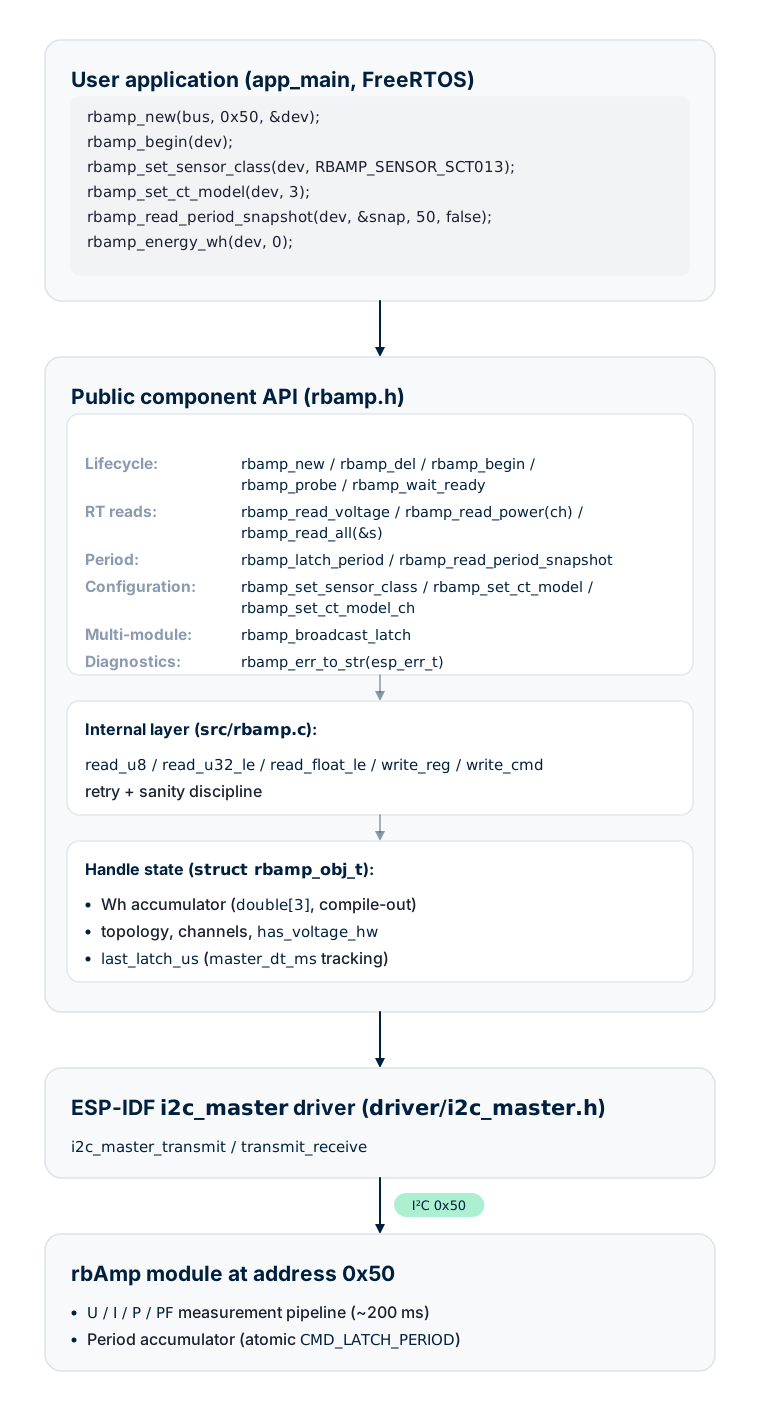
Logging and Kconfig
Unlike the Arduino library, where the log stream is configured at
runtime (setLogStream(&Serial)), here the standard ESP-IDF pattern is
used: the component logs under the "rbamp" tag via esp_log. The
log level is compiled in through the Kconfig choice
CONFIG_RBAMP_LOG_LEVEL_* (NONE / ERROR / WARN / INFO / DEBUG, INFO by
default). At NONE, log strings are removed from the binary entirely.
The runtime filter also works (via esp_log_level_set("rbamp", ...)),
but it is capped from above by the compile-time level.
Six CONFIG_RBAMP_* symbols are available in idf.py menuconfig →
Component config → rbAmp client:
| Symbol | Purpose | Default |
|---|---|---|
CONFIG_RBAMP_DEFAULT_I2C_FREQ_HZ |
SCL frequency for the shared bus | 50000 (50 kHz) |
CONFIG_RBAMP_I2C_TIMEOUT_MS |
transmit/receive timeout | 100 ms |
CONFIG_RBAMP_NACK_RETRY_ATTEMPTS |
retry attempts per single-byte read | 3 |
CONFIG_RBAMP_NACK_RETRY_GAP_MS |
gap between retry attempts | 5 ms |
CONFIG_RBAMP_DISABLE_ENERGY |
remove the Wh accumulator from the build | n |
CONFIG_RBAMP_LOG_LEVEL_* |
compile-time log-strings level | INFO |
For more details, see 09 · API reference, the "Compile-time configuration" section.
Interaction diagrams
The rbamp_begin() flow
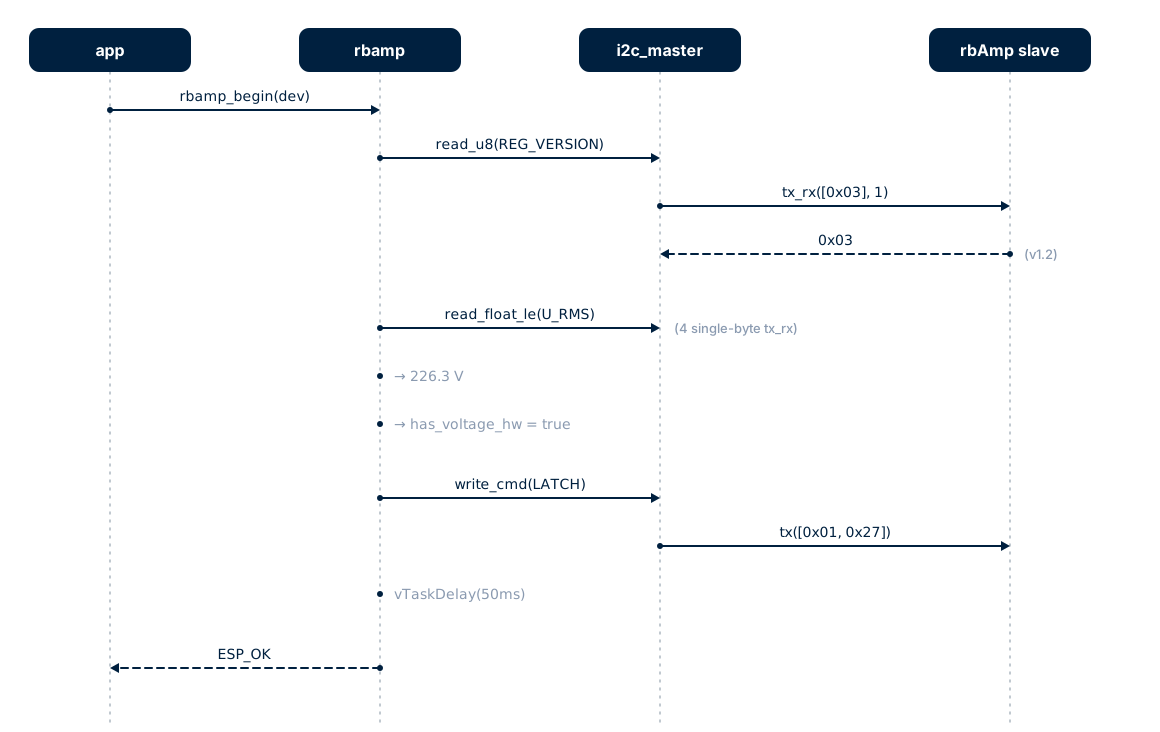
The first latch is a primer (the module returns what has been accumulated since power-up, which is unsuitable for tariff metering). The component itself records that this snapshot must be discarded — the user code never sees it.
The rbamp_read_period_snapshot(dev, &snap, 50, false) flow
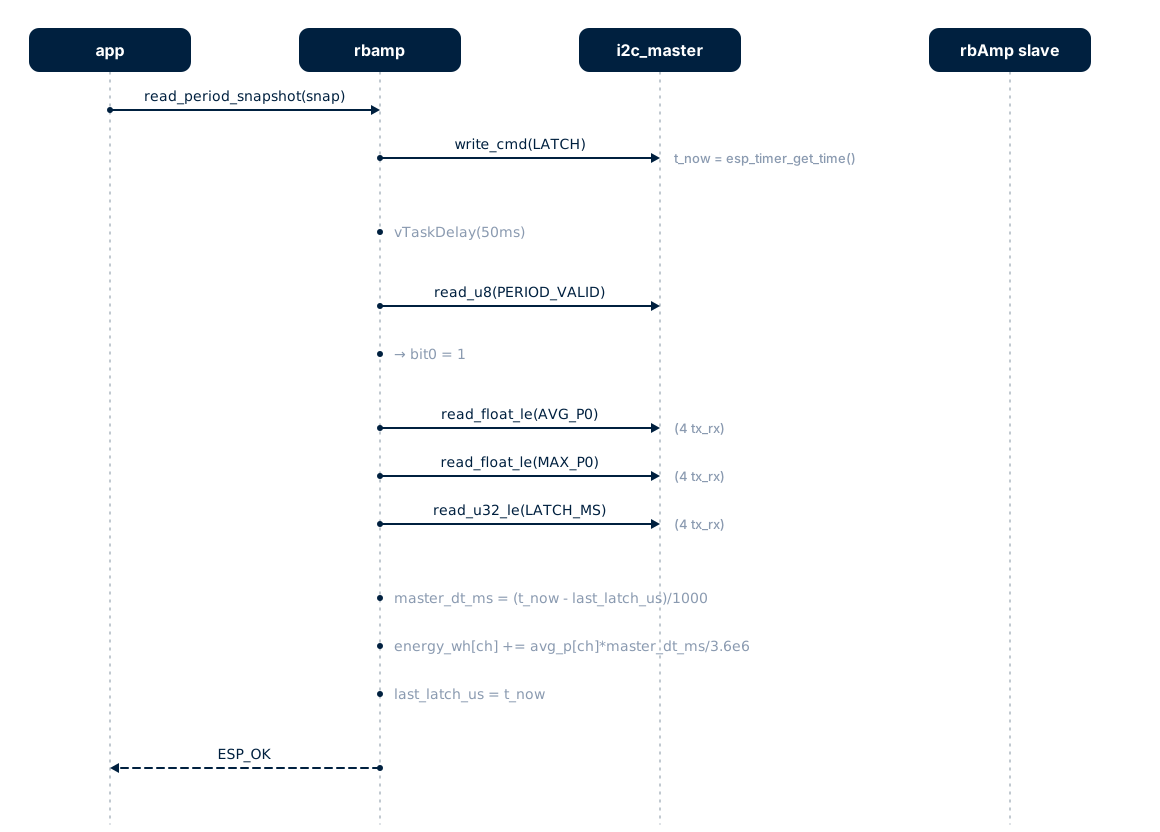
The atomic latch on the module side guarantees that every ADC micro-sample within a period lands in exactly one snapshot — with no duplication and no losses at period boundaries.
Mapping to the direct register API
A table for those migrating from their own direct-access code:
Direct API (i2c_master_transmit_receive) |
Component equivalent |
|---|---|
Manual 4-byte read + memcpy |
rbamp_read_voltage(dev, 0, &v) / rbamp_read_power(dev, ch, &p) |
tx([0x01, 0x27]); vTaskDelay(50) |
rbamp_latch_period(dev); vTaskDelay(pdMS_TO_TICKS(50)) (or directly rbamp_read_period_snapshot()) |
Checking read_u8(0x07) & 1 |
the snap.valid field after rbamp_read_period_snapshot() |
Manual formula E_Wh += avg_p * dt_s / 3600 |
rbamp_energy_wh(dev, 0) — updated automatically |
| Manual current-sensor configuration via the direct register API | rbamp_set_sensor_class(dev, cls) + rbamp_set_ct_model(dev, code) — factory presets are loaded automatically |
What's next
- 02 · Module tiers — which tier suits which task
- 04 · Hardware connection — pull-ups, bus length, ESP32-family pin-out
- 05 · Quickstart — your first working project
- 06 · Examples — a walkthrough of the ready-made IDF projects
- 09 · API reference — every public function
- 10 · Troubleshooting — when something doesn't work
Source & issues: rb-amp/rbamp-esp-idf · this page in the repo: docs/01_overview.md