API Reference
The complete public API of the rbamp package, v1.1.0. Sources:
__init__.py (re-exports),
_rbamp_core.py (the main RbAmp class),
_snapshot.py (POD structures + the exception
hierarchy), _energy.py (Wh accumulator),
_registers.py (auto-generated constants).
This chapter is a reference: signatures, return values, side effects, edge cases. For working examples, see 06 · Examples; for a quick start, see 05 · Quickstart.
Imports
from rbamp import (
    RbAmp,                     # main class
    RbAmpEnergy,               # Wh accumulator (accessed via dev.energy)
    RbAmpSnapshot,             # RT-block dataclass-style
    RbAmpPeriodSnapshot,       # period snapshot dataclass-style
    RbAmpSensorClass,          # sensor-class enum (v1.1.0+)
    TOPOLOGY_SINGLE, TOPOLOGY_SPLIT_PHASE, TOPOLOGY_THREE_PHASE,
    topology_name,             # helper: int → topology name
    # Exception hierarchy
    RbAmpError,                # base class of all errors
    RbAmpIOError,
    RbAmpTimeoutError,
    RbAmpNotReadyError,
    RbAmpStaleError,
    RbAmpParamError,
    RbAmpModeError,
    RbAmpVersionError,
    # Metadata
    __version__,               # "1.1.0"
    __protocol_version__,      # 0x03 (RBAMP_PROTOCOL_VERSION)
    REGISTERS, COMMANDS,       # raw protocol constants (advanced use)
)
Minimal import for a typical application:
from rbamp import RbAmp, RbAmpSensorClass, RbAmpErrorGeneral idioms
The API follows standard Python patterns:
- Class-based: the main
RbAmpclass owns everything — RT readings, period accounting, configuration, diagnostics. The handle holds a backend plus an energy accumulator internally. - Context manager:
with RbAmp(bus, addr) as dev:is the recommended idiom.__enter__callsdev.begin()automatically. - Properties for RT readings:
dev.voltage,dev.frequency— one property equals one I²C transaction. Channel-indexed values go through_ChannelProxy:dev.current[ch],dev.power[ch],dev.power_factor[ch]. - Methods for channel-indexed values:
dev.read_current(ch),dev.read_power(ch). Fully equivalent to the property form — use whichever is convenient. - Exceptions for errors: every error is a subclass of
RbAmpError. Use the standard Pythontry / exceptpattern (notlast_error()+ return code). - Async generator for periodic streaming:
async for snap in
  dev.stream_period(interval_s=...)
.
Types
RbAmp
class RbAmp:
    def __init__(self, bus, addr: int = 0x50): ...
The main class. One instance per slave device. bus is any
object that matches one of the "known" API signatures:
smbus2.SMBus, machine.I2C, or a custom backend (see
04 · Hardware connection).
The backend is selected automatically on the first bus access:
| bus-object method | Backend |
|---|---|
bus.readfrom_mem, bus.writeto_mem |
MachineI2CBackend (MicroPython) |
bus.read_byte_data, bus.write_byte_data |
SMBusBackend (CPython + smbus2) |
bus.read_byte, bus.register_acks, bus.now_ms |
already-wrapped (test mocks, FTDI adapters) |
If no signature matches, RbAmpParamError is raised with a
description.
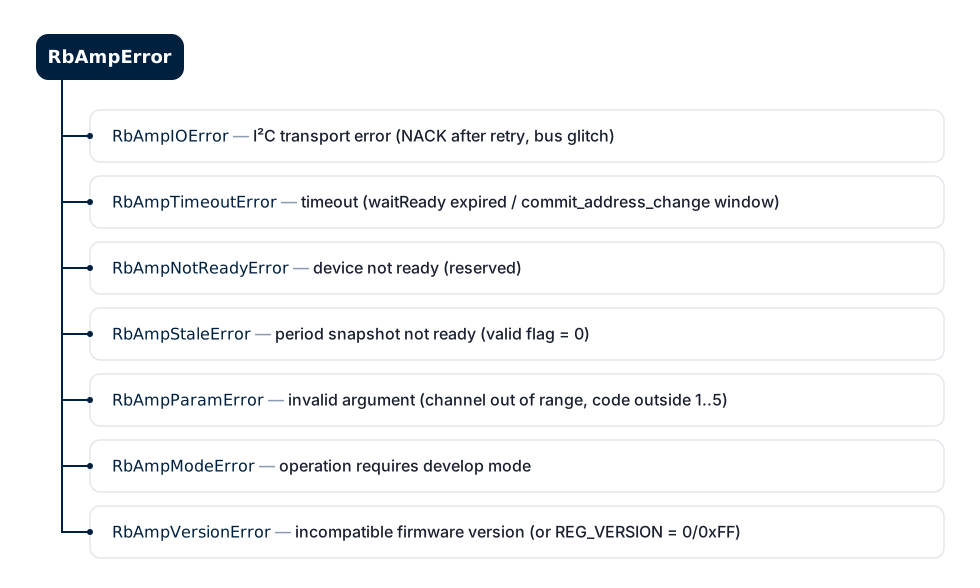
Exception hierarchy
Every error from the package is a subclass of RbAmpError, which
itself inherits from OSError (not a bare Exception). This
means existing code with except OSError: handlers keeps
catching rbAmp errors without any rewrite — the standard Python
convention for hardware-I/O drivers.
Note:
RbAmpParamErrorinherits fromRbAmpError+ValueErroron CPython (multi-base). On MicroPython, where multi-base inheritance is not supported by all ports, it falls back to single-base. From the user's standpoint,try / except RbAmpParamErrorworks the same either way. However,try / except ValueErrorcatches it only on CPython — on MicroPython that handler will be missed. Code that needs to run cross-platform must catchRbAmpParamErrorexplicitly.
Standard usage:
try:
    snap = dev.read_period_snapshot()
except RbAmpStaleError:
    # period not ready yet — the master timestamp was pinned by the package
    continue
except RbAmpIOError as e:
    log.warning("bus failure: %s", e)
except RbAmpError as e:
    log.error("unexpected: %s", e)
RbAmpSensorClass (v1.1.0+)
class RbAmpSensorClass(IntEnum):
    UNSET       = 0   # factory value after reset
    SCT_013     = 1   # SCT-013 series (shipping default)
    WIRED_CT    = 2   # Reserved — STANDARD tier
BUILTIN_CT = 3 # Reserved — PRO tierNote: on CPython this uses
IntEnumfrom the stdlibenummodule. On MicroPython ports without anenummodule, it falls back to a plain class with the same member values. From the user's standpoint both forms are identical:dev.set_sensor_class(RbAmpSensorClass.SCT_013)ordev.set_sensor_class(1)— both work.
Only UNSET and SCT_013 are meaningful for the current
firmware. The reserved values are present in the API for
compatibility with future SKUs — for now, passing them to
set_sensor_class() raises RbAmpParamError.
RbAmpSnapshot
Returned by dev.read_all(). A plain Python class (not a
@dataclass, for MicroPython compatibility). All fields are in SI
units.
class RbAmpSnapshot:
    voltage:        float       # V — RMS voltage
    voltage_peak:   float       # V — peak voltage
    current:        list        # [ch0, ch1, ch2] — RMS current per channel, A
    current_peak:   list        # [ch0, ch1, ch2] — peak current, A
    power:          list        # [ch0, ch1, ch2] — active power (signed), W
    power_factor:   list        # [ch0, ch1, ch2] — dimensionless, −1..+1
    frequency:      float       # Hz
    topology:       int         # TOPOLOGY_* constant
    channels:       int         # 1..3 — number of valid channels
    has_voltage_hw: bool        # True if a voltage sensor is present
Unused channels (beyond channels) are filled with zeros.
RbAmpPeriodSnapshot
Returned by dev.read_period_snapshot(). The energy-accounting
primitive.
class RbAmpPeriodSnapshot:
    avg_p:        list   # [ch0, ch1, ch2] — average P over the period, W
    max_p:        float  # peak instantaneous power on channel 0
    latch_ms:     int    # period duration (the device's view)
    master_dt_ms: int    # master wall-clock dt since the last latch
    valid:        bool   # True if the latch-ready flag was set
For energy integration use
master_dt_ms, notlatch_ms— the module's internal timer has limited accuracy.
Topology constants
TOPOLOGY_SINGLE      = 1   # 1 current channel (UI1 / I1)
TOPOLOGY_SPLIT_PHASE = 2   # 2 current channels (UI2 / I2)
TOPOLOGY_THREE_PHASE = 3   # 3 current channels (UI3 / I3)
topology_name(topology: int) -> str   # 1 → "SINGLE", 2 → "SPLIT_PHASE", ...
Lifecycle
RbAmp(bus, addr=0x50)
Constructor. Backend resolution happens in __init__. No I²C
traffic is generated until begin().
| Parameter | Description |
|---|---|
bus |
I²C bus object (smbus2.SMBus, machine.I2C, or a wrapper) |
addr |
7-bit slave address. Range 0x08..0x77, default 0x50 |
Raises: RbAmpParamError if the bus object is not recognized
or addr is out of range.
dev.begin()
Probes the device, caches the topology, and primes the LATCH.
Sequence:
- Read
REG_VERSION— raisesRbAmpIOErroron NACK,RbAmpVersionErrorif0x00/0xFFis returned. - Cache the topology (on current firmware
begin()does not auto-probe; it uses the hint from the constructor). - Read
U_rmsto determine whether a voltage sensor is present (threshold 1.0 V). - Write
CMD_LATCH_PERIOD(the primer) + wait 50 ms. The first snapshot after power-up is discarded. - Store
time.monotonic()(ortime.ticks_ms()on uPy) for subsequent energy integration.
Idempotent: safe to call again.
Context manager
with RbAmp(bus, 0x50) as dev:
    # dev.begin() has already been called in __enter__
    ...
# __exit__ — no-op (closing the bus is the caller's responsibility)
The recommended idiom. The package's __exit__ does NOT close
the bus — management of the bus object stays with the caller (the
typical pattern is nested
with SMBus(1) as bus, RbAmp(bus, 0x50) as dev:).
dev.probe() -> bool
A lightweight liveness check. A single read of REG_VERSION with
no side effects.
Returns: True if the slave ACK'd and reported a supported
version; False otherwise. Does not raise — meant for
polling scenarios.
dev.wait_ready(timeout_ms=1000) -> None
Polls the module's ready flag until bit 0 is set. Useful after power-up — the module may need up to 200 ms to produce its first RT window.
Raises: RbAmpTimeoutError if the bit is not seen before
timeout_ms elapses.
Properties — handle state
dev.firmware_version: int      # REG_VERSION: 0x01 (v1.0), 0x02 (v1.1), 0x03 (v1.2)
dev.topology:         int      # TOPOLOGY_* constant
dev.topology_name:    str      # "SINGLE" / "SPLIT_PHASE" / "THREE_PHASE"
dev.channels:         int      # 1..3
dev.has_voltage_hw:   bool     # True if begin() detected U_rms > 1.0
dev.address:          int      # 7-bit I²C address (updated after commit_address_change)
firmware_version is a live property: every read touches the
bus (one single-byte read of REG_VERSION). Cache it
application-side if you poll it in a hot loop: read
fw = dev.firmware_version once after begin(). If begin()
has not been called yet, firmware_version raises RbAmpIOError
(the module may NACK while the handle is still "cold").
The other properties (topology, channels, has_voltage_hw,
address) are cached in the handle and return the values stored
after begin() without touching the bus.
Real-time readings (RT block, 200 ms refresh)
All methods raise RbAmpIOError on a communication failure (NACK
after retry, or a sanity reject) or RbAmpParamError on an
invalid argument.
Properties
dev.voltage         -> float   # V — RMS voltage
dev.voltage_peak    -> float   # V — peak voltage
dev.frequency       -> float   # Hz — mains frequency
Channel-indexed via _ChannelProxy — they support [ch]
indexing and iteration:
dev.current         # _ChannelProxy → dev.current[0], dev.current[1], ...
dev.current_peak    # _ChannelProxy
dev.power           # _ChannelProxy
dev.power_factor    # _ChannelProxy
Usage:
i0 = dev.current[0]                       # a single channel
for i in dev.current:                      # iterate over all valid channels
    print(i)
total = sum(p for p in dev.power)          # sum of all channels
len(dev.current) equals dev.channels (1..3).
Methods (fully equivalent to the property form)
dev.read_voltage(phase=0)         -> float
dev.read_voltage_peak(phase=0)    -> float
dev.read_current(ch=0)            -> float
dev.read_current_peak(ch=0)       -> float
dev.read_power(ch=0)              -> float       # signed
dev.read_power_factor(ch=0)       -> float
dev.read_frequency()              -> float
One-shot read of the entire RT block
dev.read_all() -> RbAmpSnapshotEquivalent to consecutive read_voltage + read_voltage_peak +
read_current(0..N) + read_current_peak(0..N) + read_power(0..N) +
read_power_factor(0..N) + read_frequency. Unused channels
(beyond channels) are filled with zeros.
Raises: RbAmpIOError if any sub-read fails.
Period accounting
See 01 · Overview for the big picture and 05 · Quickstart Step 5 for a minimal template.
dev.latch_period() -> None
Writes CMD_LATCH_PERIOD. Does not wait — the caller must allow a
50 ms settle and check dev.is_period_valid() before reading.
For most tasks, use read_period_snapshot() — it encapsulates the
whole sequence.
dev.is_period_valid() -> bool
Reads the latch-ready bit. Returns True if the latest snapshot
is fresh.
dev.read_period_avg_power(ch=0) -> float
The average active power on a channel over the latched period.
Must be called after latch_period() + a 50 ms settle + a valid
check.
dev.read_period_max_power() -> float
The peak instantaneous power on channel 0 over the latched period. Channel 0 only on v1 firmware.
dev.read_period_latch_ms() -> int
The period duration from the device's perspective, in ms.
Diagnostic value. The module's internal timer has limited accuracy. For energy integration use
master_dt_msfromRbAmpPeriodSnapshot, not this field.
dev.read_period_snapshot(settle_ms=50, skip_latch=False) -> RbAmpPeriodSnapshot
The recommended entry point for period accounting. The full sequence under the hood:
- If
skip_latch=True, skip the LATCH write (for the multi-module pattern after a manual series of LATCH commands). - Otherwise, write
CMD_LATCH_PERIOD. - Capture
time.monotonic()to computemaster_dt_ms. time.sleep(settle_ms / 1000)— 50 ms by default.- Check the latch-ready flag. If 0, raise
RbAmpStaleError(after pinning the timestamp first, so the next snapshot does not double-countdt). - Read
avg_p[0..channels-1]+max_p+latch_ms. - Update the timestamp + call
energy.tick(snap)for Wh integration (unless the accumulator is disabled viaenergy.disable()).
| Parameter | Description |
|---|---|
settle_ms |
Wait after LATCH, in ms. Default 50. |
skip_latch |
If True, do not write LATCH; read only. |
Raises: RbAmpStaleError (snapshot stale); RbAmpIOError
(bus failure).
async dev.stream_period(interval_s=60.0, skip_stale=True)
An async generator that yields RbAmpPeriodSnapshot at the
interval_s interval. Works on CPython asyncio and MicroPython
uasyncio (on MicroPython ≥ 1.20, import asyncio also works;
for earlier versions use import uasyncio as asyncio).
async for snap in dev.stream_period(interval_s=60.0):
    # snap is a RbAmpPeriodSnapshot; .valid is guaranteed True (skip_stale=True by default)
print(snap.avg_p[0])| Parameter | Description |
|---|---|
interval_s |
The interval between latches (recommended ≥ 30 s) |
skip_stale |
True (default) — stale snapshots are skipped automatically. False — they are yielded with snap.valid=False, and your code must check if not snap.valid: continue itself |
⚠ CPython: blocks the event loop. Under the hood,
stream_period()calls the synchronous, blockingread_period_snapshot()— which does atime.sleep(0.05)settle plus ~50–100 ms of single-byte bus reads. On CPython this blocks the entireasyncioevent loop for those 100 ms — other coroutines (MQTT, HTTP, WiFi keepalive) get no CPU. For production servers, wrap it inrun_in_executor:```python import asyncio
async def stream_period_nonblocking(dev, interval_s=60.0): loop = asyncio.get_event_loop() while True: await asyncio.sleep(interval_s) snap = await loop.run_in_executor(None, dev.read_period_snapshot) if snap.valid: yield snap ```
On MicroPython the problem is smaller — the uasyncio scheduler yields to other tasks less often, and blocking I²C is considered acceptable in embedded async patterns. If you need non-blocking behavior, use a separate thread via
_thread.start_new_thread(on ESP32 µPy).
Energy accounting (master-side accumulator)
dev.energy — an RbAmpEnergy instance
A per-channel Wh accumulator. Accessed through a property — the package owns the instance:
dev.energy.wh(ch=0)         -> float    # current Wh total for the channel
dev.energy.reset(ch=0)      -> None     # zero a single channel
dev.energy.reset_all()      -> None     # zero all channels
dev.energy.disable()        -> None     # turn off auto-integration
dev.energy.enable()         -> None     # turn it back on
The accumulator updates automatically on every successful
dev.read_period_snapshot(). It is signed — a negative value
means net export.
Integration formula:
wh[ch] += snap.avg_p[ch] × master_dt_ms / 1000 / 3600
         [W]             [milliseconds]              → [Wh]
dev.energy.disable() is useful for deep-sleep scenarios where
the master itself owns Wh persistence in RTC memory — see
06 · Examples, Scenario 9.
Sensor configuration
A two-step sequence. For a detailed model-selection guide, see 03 · Current sensor selection.
dev.set_sensor_class(cls) -> None (v1.1.0+)
Sets the current-sensor class and persists it to flash. Blocking, ~705 ms.
dev.set_sensor_class(RbAmpSensorClass.SCT_013)
# or equivalently:
dev.set_sensor_class(1)| Parameter | Description |
|---|---|
cls |
An RbAmpSensorClass enum or an int 0..3 |
Raises:
RbAmpParamError—clsis not in {UNSET,SCT_013} (the reserved values are not supported on the current SKU)RbAmpIOError— communication failure
On v1.2+ firmware it must be called before set_ct_model*().
On v1.0/v1.1 it is a no-op (the register write goes through, but
the firmware ignores it).
dev.set_ct_model(code) -> None
The single-parameter (legacy) form — sets the CT-clamp model on channel 0 only.
code |
Model |
|---|---|
| 1 | SCT-013-005 |
| 2 | SCT-013-010 |
| 3 | SCT-013-030 |
| 4 | SCT-013-050 |
| 5 | SCT-013-100 |
Raises:
ValueError(and alsoRbAmpParamError) —codeoutside 1..5RbAmpModeError— on v1.2+ firmware ifset_sensor_class()was not called (see the message below)RbAmpIOError— communication failure
The RbAmpModeError message on v1.2 without a pinned class:
REG_SENSOR_CLASS is UNSET on v1.2+ firmware;
call dev.set_sensor_class(RbAmpSensorClass.SCT_013) first
Equivalent to dev.set_ct_model_ch(0, code) on v1.2+ firmware.
dev.set_ct_model_ch(channel, code) -> None (v1.1.0+)
The per-channel form. Sets the CT-clamp model on a specific channel.
Under the hood: write REG_CT_MODEL → command
CMD_SET_CT_MODEL_CH0/1/2 → 5 ms settle → CMD_SAVE_GAINS →
700 ms. Blocking, ~705 ms.
Important: call order matters. Writing
REG_CT_MODELalso fires a legacy callback on the device side, which applies the preset to channel 0 as a side effect. Assign channels in descending index order:
python
dev.set_ct_model_ch(2, 5)  # channel 2 = SCT-013-100
dev.set_ct_model_ch(1, 3)  # channel 1 = SCT-013-030
dev.set_ct_model_ch(0, 1)  # channel 0 = SCT-013-005
Final state:
ch0=1, ch1=3, ch2=5. ✓
Raises:
RbAmpVersionError—dev.firmware_version < 0x03(v1.2)RbAmpParamError—channeloutside 0..2 orcodeoutside 1..5RbAmpModeError—set_sensor_class()was not called (v1.2+ guard)
dev.save_gains() -> None
A "bare" CMD_SAVE_GAINS write without any accompanying register
changes.
⚠ Normally called internally by the package. A bare
save_gains()is appropriate ONLY if the caller has manually written to non-public calibration registers via raw bus access — this is an out-of-warranty operation that bypasses the SKU-matched preset table. Incorrect values will produce wrong current/power readings with no explicit warning. Each call performs a flash erase+write cycle (~700 ms); flash endurance is finite (~10,000 cycles per page) — do not call it in a loop.
Raises: RbAmpIOError on a communication failure.
dev.prepare_address_change(new_addr) -> None
Arm an address change (step 1 of 2). Validates the range (0x08..0x77,
≠ current) and records the "arm" timestamp. No bus I/O. Must be
followed by commit_address_change() within 5 seconds, or the arming
expires.
Raises:
RbAmpParamError—new_addroutside 0x08..0x77 or equal to the current addressRbAmpIOError— communication failure
dev.commit_address_change() -> None
Commit the armed change (step 2 of 2). v1.3 two-phase commit,
production-OK (no mode gate): writes REG_I2C_ADDRESS = candidate
(RAM), REG_ADDR_COMMIT_MAGIC = 0xA5 (arm; an anti-fat-finger
interlock — the commit opcode is refused without it), CMD_COMMIT_ADDR
(opcode 0x30, persists to flash), then CMD_RESET. Updates the
client's internal address on success; bus unavailable ~1 s.
An additional subtlety:
⚠ Restart and re-enumeration after commit. After a successful commit, the device resets and re-enumerates at the NEW address. Subsequent calls on this handle instance address the new address transparently — but any OTHER master on the bus (another Python script, an ESP-IDF component, a debug probe) will keep thinking the device is at the old address until its internal state is updated manually.
Raises:
RbAmpParamError— nothing is armed (callprepare_address_change()first)RbAmpTimeoutError— the arm is older than 5 secondsRbAmpIOError— communication failure
Arm state is cleared even on a partial NACK, so a failed commit does not leave a stale re-armed change.
dev.factory_reset() -> None
The CMD_FACTORY_RESET command + a 1500 ms wait.
⚠ Destructive operation. Erases ALL flash parameters (CT model, sensor class, calibration coefficients, I²C address). The module returns to factory defaults —
RbAmpSensorClassbecomesUNSET,REG_CT_MODELbecomes 0. Any configuration previously applied viaset_sensor_class()/set_ct_model*()is gone. The next user MUST re-apply bothset_sensor_class()andset_ct_model*()before accounting works again. This is not a "soft restart" — for a soft restart usereset().factory_reset()is reserved for recovering from a known-bad state or handing the module to another user / installation.
Raises: RbAmpIOError on a communication failure.
dev.reset() -> None
The CMD_RESET command + a 100 ms wait. A soft restart of the
device with no loss of flash parameters.
Raises: RbAmpIOError on a communication failure.
Multi-module bus (static)
dev.enable_gc(enable=True) -> None
Set/clear REG_FLEET_CONFIG bit 0 (GC_ENABLE) so the device honours
General-Call latch frames. Enabling is one-time; persist with the
module's normal config-save.
RbAmp.broadcast_latch_group(bus, group=0, tick=0) -> bool
A static method. Transmits the 5-byte General-Call frame
[0xA5, 0x27, group, tick_lo, tick_hi] to address 0x00; every
GC-enabled module (FLEET_CONFIG bit 0) with a matching group — or
group == 0 for all-call — latches its period accumulator atomically
and stores tick. Implemented in v1.3 firmware. After the
broadcast, read each device with
read_period_snapshot(..., skip_latch=True).
RbAmp.broadcast_latch(bus) -> bool
A static method — all-call convenience for
broadcast_latch_group(bus, group=0, tick=0); latches every GC-enabled
module on the bus. On v1.0/v1.1 firmware GC is disabled and the frame
is harmlessly ignored → fall back to a sequential series of
latch_period() on each device plus a shared settle.
Fleet helpers: RbAmpFleet.enable_gc_all(group=0) and
RbAmpFleet.gc_latch(group=0, tick=None, settle_ms=50).
For details, see 06 · Examples, Scenario 3.
Diagnostics
dev.set_logger(log_callable) -> None
An optional diagnostics sink. log_callable takes a single str
argument. When set, the package briefly logs probe() results,
stale snapshots, and mode rejections.
Typical usage:
import logging
log = logging.getLogger("rbamp")
log.setLevel(logging.INFO)
log.addHandler(logging.StreamHandler())
dev.set_logger(log.info)
# Or the simplest option — a plain print:
dev.set_logger(print)
dev.sanity_reject_count: int
A counter of float values rejected by the sanity filter
(!isfinite(x) or |x| > 10000). Steady-state is 0. A nonzero
value after retry mitigation usually means a rare I²C-stack
artifact that survived the retry layer.
MachineI2CBackend diagnostic counters (MicroPython only)
MachineI2CBackend (the internal backend on MicroPython) exposes
two counters:
backend.retry_exhaustion_count— how many times the retry loop was exhausted without success (RbAmpIOErrorwas raised)backend.retry_count_total— how many times the retry loop recovered successfully with a silent retry
These counters are accessible through the advanced API:
from rbamp._io_micropython import MachineI2CBackend
from rbamp import RbAmp
backend = MachineI2CBackend(i2c, retry_attempts=5)
dev = RbAmp(backend, 0x50)   # the address is a RbAmp parameter, not a backend one
# ...soak-test for an hour...
print("retries succeeded:", backend.retry_count_total)
print("retries exhausted:", backend.retry_exhaustion_count)
print("sanity rejects:",    dev.sanity_reject_count)
SMBusBackend (CPython) has no retry layer — the Linux kernel I²C
driver is not subject to the NACK pattern.
dev.reset_counters() -> None
Zeros all counters (RbAmp + the backend, if it is a
MachineI2CBackend). Use it at the start of a soak test.
Metadata and protocol constants
rbamp.__version__              # "1.1.0" — PEP 440 version
rbamp.__protocol_version__     # 0x03  — RBAMP_PROTOCOL_VERSION
rbamp.RBAMP_REG_SCHEMA_CRC32   # CRC32 of the schema codegen contract
REGISTERS and COMMANDS are auto-generated protocol-level dicts:
from rbamp import REGISTERS, COMMANDS
REGISTERS["U_RMS"]           # 0x86
REGISTERS["PERIOD_VALID"]    # 0x07
COMMANDS["LATCH_PERIOD"]     # 0x27
COMMANDS["SAVE_GAINS"]       # 0x26
COMMANDS["FACTORY_RESET"]    # 0xAA
Used internally by the package. Exposed for advanced users who do raw transit through their own backend; ordinary users never touch them.
References
- 05 · Quickstart — your first working script
- 06 · Examples — working scenarios
- 10 · Troubleshooting — decoding errors and fixing common problems
- Sources:
__init__.py,_rbamp_core.py,_snapshot.py,_energy.py,_io_micropython.py,_io_smbus.py
← Cloud Integrations | Contents | Troubleshooting →
Source & issues: rb-amp/rbamp-python · this page in the repo: docs/09_api_reference.md