00 · Overview
What is rbAmp
📦 Documentation & code on GitHub:
rb-amp/rbamp-docs(this documentation set). Platform libraries:rbamp-arduino·rbamp-esp-idf·rbamp-python·rbamp-esphome. Current release v1.5.0 (wire-protocol v1.3).
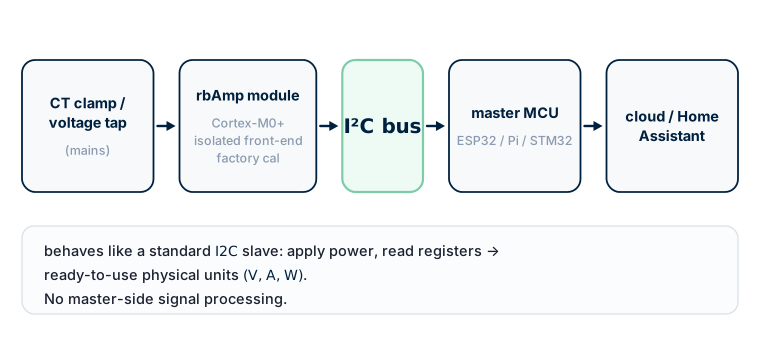
rbAmp is a compact hardware module for precision measurement of AC mains parameters over an I2C interface. It is built around a Cortex-M0+ microcontroller with an integrated isolated sensor front-end and factory-stored calibration.
From the integrator's point of view, rbAmp behaves like a standard I2C slave: apply power, read registers — receive ready-to-use physical-unit values (volts, amperes, watts). No signal processing is required on the master side.
What it measures
| Quantity | Register (I0) | Type | Range | Accuracy |
|---|---|---|---|---|
| RMS voltage, U_rms | 0x86 |
float32, V | 0…300 V | ±0.5% |
| Peak voltage, U_peak | 0x8A |
float32, V | 0…450 V | ±1% |
| RMS current, I_rms | 0x8E |
float32, A | 0…100 A (SKU-dependent) | ±0.5%…±1% |
| Peak current, I_peak | 0x9A |
float32, A | 0…140 A | ±1% |
| Active power, P | 0xA6 |
float32, W (±) | ±23 kW | ±1% |
| Power factor, PF | 0xB2 |
float32 (±) | −1…+1 | ±0.01 at PF ≈ 1 (resistive load) |
| Reactive power, Q | 0xD0 |
float32, VAR (±) | same as P | — |
| Line frequency | 0x20 |
u8, Hz | 45…65 Hz | ±0.5 Hz |
| Time-averaged P over period | 0xDC |
float32, W | same as P | ±1% |
The full register map is detailed in 03_realtime_polling.md and 04_period_metering.md.
Applications
- Tariff metering — energy billing in 1-min, 15-min, 1-hour, daily, monthly, or yearly intervals
- Smart home — whole-house consumption monitoring, per-load sub-metering, generation tracking
- Load control — feedback signal for power-regulating devices (water heaters, resistive loads, inverters)
- Energy balancing — separate accounting of consumption and generation in homes with solar
- Grid quality monitoring — both on the consumer side and on the utility side
Module variants
| Variant | U | I channels | P | Status | When to choose |
|---|---|---|---|---|---|
| UI1 | yes | 1 | yes | shipping | single accounting point — whole-house meter, boiler, single inverter |
| UI2 | yes | 2 | yes | shipping | two sub-meters on one phase (lights + outlets, generation + consumption) |
| UI3 | yes | 3 | yes | roadmap (not buildable on current MCU package) | three flows on one phase |
| UI5 / UI7 | yes | 5 / 7 | yes | shipping | high-channel-count phase monitoring (large panels, lab benches) |
| I1 | no | 1 | no | shipping | current-only monitor (master computes P with its own U source) |
| I2 | no | 2 | no | shipping | two-channel current monitor |
| I3 | no | 3 | no | shipping | three-channel current monitor |
| I6 / I8 | no | 6 / 8 | no | roadmap | multi-channel current monitor |
On I-only variants, active power is not computed (
P_real = 0), andPERIOD_AVG_P_Wreturns 0. The master must either provide its own voltage source for power calculation, or use the current data alone.
Product tiers
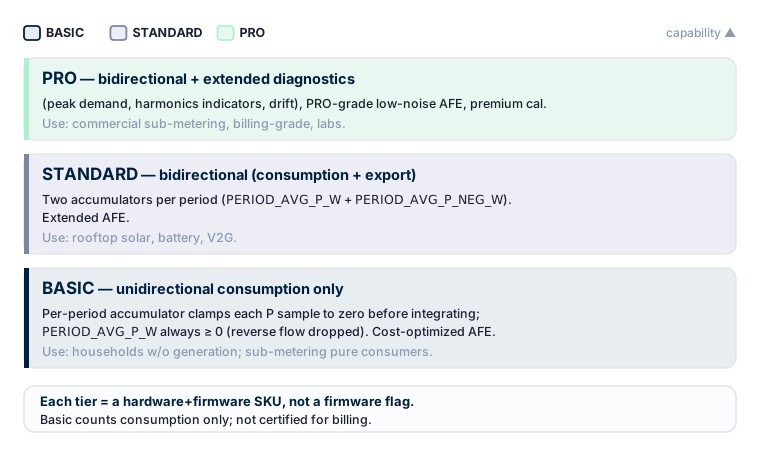
rbAmp is offered in three product tiers. Each tier is a complete combination of hardware revision and firmware — not a firmware-only flag. Moving between tiers requires a physical SKU change, not a firmware update.
BASIC — entry-level product line
- Hardware: cost-optimized analog front-end suitable for typical residential loads.
- Firmware: unidirectional consumption metering. The per-period accumulator clamps each per-window active-power sample to zero before integrating: only positive (consumed) energy is counted, mirroring a classical mechanical disc meter that only spins forward.
PERIOD_AVG_P_Wis always ≥ 0; reverse-flow events are dropped from the period accumulator.- Use cases: households without on-site generation; sub-metering of pure consumers (heaters, motors, appliances).
STANDARD — bidirectional product line
- Hardware: extended analog stack supporting accurate measurement of both consumption and reverse flow.
- Firmware: bidirectional metering. Two separate accumulators per period — one for consumption, one for export — exposed as two register groups (
PERIOD_AVG_P_WandPERIOD_AVG_P_NEG_W). - Use cases: homes with rooftop solar, wind generators, battery storage, regenerative loads, V2G EV chargers.
PRO — premium product line
- Hardware: PRO-grade analog front-end (lower noise, tighter linearity), premium factory calibration, optional extended channel sets.
- Firmware: bidirectional metering plus extended diagnostics (peak demand windows, harmonics indicators, drift monitoring registers).
- Use cases: sub-metering for commercial tenants, billing-grade installations, instrumentation labs, energy-intensive industrial loads.
Where the tier shows up in this documentation
Throughout the chapters, features that depend on the tier are explicitly marked, for example:
STANDARD / PRO only — on a BASIC module this register is not available.
The base register block at 0x00..0xCF is identical across all tiers; the additional STANDARD and PRO registers reside above 0xCF.
Key features
- I²C slave: recommended 50 kHz; workable at 100 kHz with application-level retry. 400 kHz is not validated for v1.3.
- Address: 7-bit
0x50by default, reprovisionable to the0x08..0x77range via two-phase commit (see 02_initialization.md). - DATA_READY (DRDY): optional open-drain pin, ~10 µs LOW pulse every ~200 ms, marks the moment when RT registers are coherent.
- Atomic period latch: command
0x27freezes the per-period averaged power; one write closes and opens — no dropped or duplicated samples at the boundary. - General-Call broadcast latch: address
0x00reserved for simultaneous LATCH on all modules sharing a bus. Opt-in per module viaFLEET_CONFIG.bit0(default OFF). When OFF, GC frame NACKs at the bus level — masters detect this and fall back to per-module sequential latch (skew on 50 kHz bus is ~1 ms × N, ≪ 0.03% of 60 s period). See 04_period_metering.md for enable sequence and frame format. - Master-side wall-clock: energy is computed master-side as
avg_P × dt_master; the chip-side period timestamp register (0xEC) is diagnostic-only (can undercount up to ~30% under load — by design). Eliminates per-module crystal drift in multi-module systems. - Calibration in flash: factory calibration (gains, noise floor, phase compensation) is stored on-chip; no user calibration is required — the master only writes
SENSOR_CLASSandCT_MODELper channel. - Auto-configuration: the module starts measuring immediately after power-on (~250 ms to the first valid result, ~700 ms additional for first persistence write).
Roadmap
Planned future SKUs (mentioned here for forward-compatible system design):
| Model | Mains type | Channels | Status |
|---|---|---|---|
| rbAmp-U2I2 | US split-phase 2×120 V | 2U + 2I | planned |
| rbAmp-U3I3 | True three-phase 380/400 V | 3U + 3I | planned |
The current documentation covers single-phase models only. The multi-phase API will be an extension of the existing register map — registers 0x86..0xEF of single-phase modules remain forward-compatible (extension, not replacement).
What rbAmp does not do
- Does not integrate energy (Wh) internally — energy accumulation is the master's responsibility (see 04_period_metering.md)
- Does not drive loads, contain automation logic, or run programmable rules
- Has no built-in display
Next
- 01_hardware.md — connection, power, wiring
- 02_initialization.md — first power-on