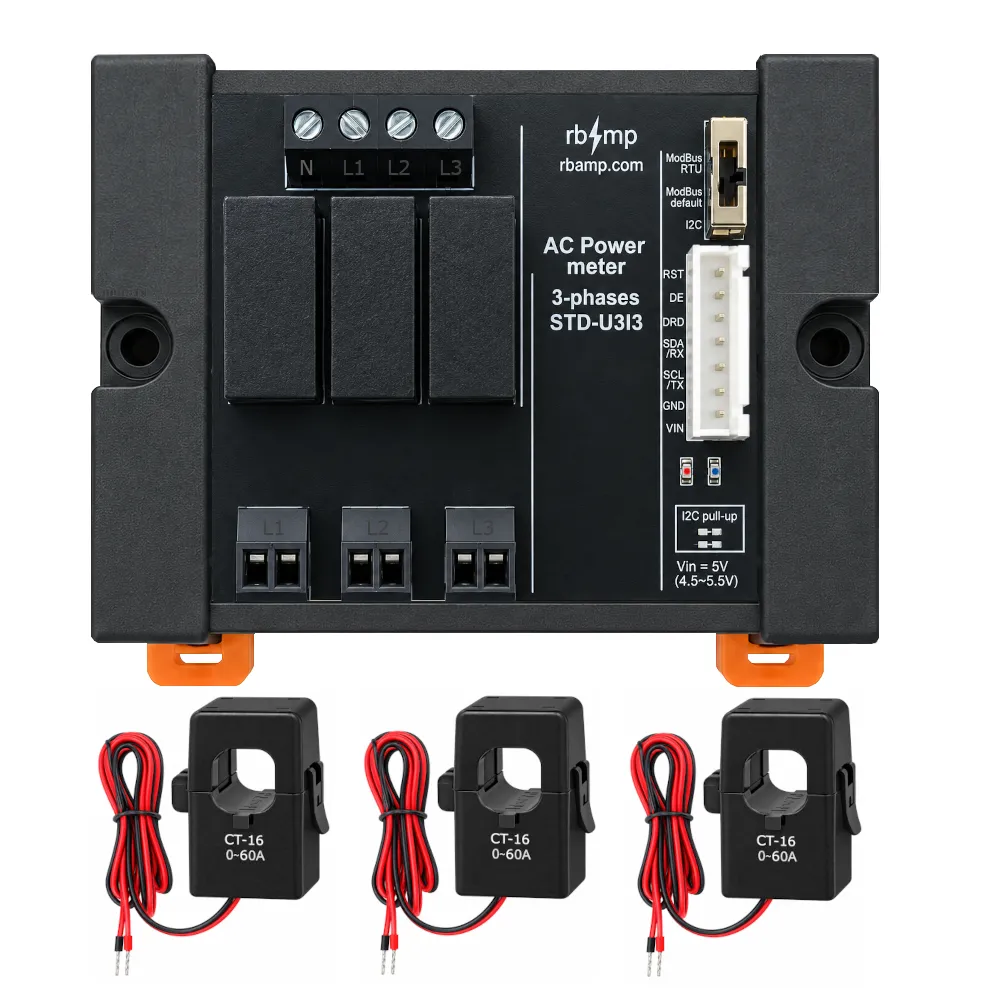
available rbAmp Standard (STD)
For a three-phase input, a workshop or production floor, a charging site, a three-phase solar system.
Neutral required — voltage terminal N, L1, L2, L3.
Pick this if:
- Three-phase input of a building or workshop
- A meter per tenant
- Three-phase metering per charger
Which rating? Pick the smallest kit rating above the circuit's maximum current: a 40 A main → 60 A; a 63 A main → 100 A. The sensors are calibrated with their channels — keep each sensor on the channel it is labelled for.
In the box
- the meter in its DIN-clip enclosure
- three current sensors, 60 A or 100 A as selected, calibrated with their channels and labelled
[[OPS: box contents and photo]]
Features
| Feature | Status |
|---|---|
| works without a master (Modbus RTU) | available |
| 3 voltage + 3 current channels, sampled synchronously | available |
| per-phase and total readings | available |
| import and export by the phase balance — the standard meter convention | available |
| phase angles and phase-sequence check | available |
| energy counters per current channel | available |
| virtual unit ids: on Modbus each current channel also answers as its own read-only single-phase view (voltage, current, power) | available |
| all STD features of STD-UI1: counters saved every second, snapshot banks, hourly history, update with rollback | available |
The module has no RS-485 transceiver: the connector carries UART TTL and a driver-enable line for an external transceiver.
Measured characteristics per kit rating: see the table on the STD page.
SDM630, SDM120 and Eastron are names of a third-party manufacturer's meters, used only to state compatibility with their Modbus register protocol.
Installation and safety
STD-UI1 and STD-U3I3 are galvanically isolated: the connector side (VIN, GND, bus) is isolated from the mains measurement inputs. The board comes in an enclosure that covers the lower part with all mains circuits; the upper part with the interface connector is open and isolated; only the voltage-sensor terminal comes out, in a plastic housing. The enclosure has a DIN clip and can be installed in a cabinet.
- one 7-pin interface connector: power, ground, bus, data-ready, driver enable, reset
- voltage input: a thin wire is enough (AWG26–22); a fuse in the L line is mandatory, rated up to 0.1 A
- voltage terminal N, L1, L2, L3 — neutral required; fuse each L line
- sensors: the kit comes pre-connected; each sensor stays on the channel it is labelled for; follow the arrow for the import direction
- The measurement inputs connect to mains.
- Install the meter in a closed electrical cabinet.
- Qualified personnel only.
- Switch the mains off before connecting or moving any wire.
- The isolated interface side does not make the meter safe to work on live.
STD is a sub-metering and monitoring instrument. It is not a utility settlement meter and makes no certification claims.
More: STD › Designed for electrical panel installation