09 · YAML schema reference
This chapter is the complete YAML schema reference for the rbamp ESPHome external component. If a key isn't here, it isn't in the schema.
Contents:
- Component block —
rbamp: - Sensor platform —
sensor.platform: rbamp - Data flow and timings
- I²C bus settings
1. Component block — rbamp:
The top-level rbamp: block registers a component instance. It inherits from PollingComponent (which provides update_interval) and i2c.I2CDevice (which provides address and the I²C-bus handle). MULTI_CONF: True — any number of rbamp: blocks can coexist in a single YAML, each referring to its own I²C slave.
rbamp:
  id: meter1
  address: 0x50
  update_interval: 60s
  drdy_pin: GPIO4
  sensor_class: SCT_013
  ct_model: SCT_013_030
  # or for UI3 with mixed CT clamps:
  # ct_models: [SCT_013_005, SCT_013_030, SCT_013_050]
  bidirectional: false
  new_address: 0x51
  broadcast_latch: false
  topology: SINGLE
id
| Attribute | Value |
|---|---|
| Type | id (ESPHome identifier) |
| Default | Auto-generated |
| Required | No |
Assigns a stable identifier to the instance. Sensors reference it via rbamp_id: meter1. With multiple rbamp: blocks, an explicit id is required.
rbamp:
  id: kitchen_meter
address
| Attribute | Value |
|---|---|
| Type | i2c_address (7-bit, 0x08..0x77) |
| Default | 0x50 |
| Required | No |
The current I²C address of the rbAmp module. Factory default is 0x50. After applying an address change (via new_address) — update this key to the new value and remove new_address.
Permitted range: 0x08..0x77 (reserved 7-bit I²C addresses are excluded).
rbamp:
  address: 0x52   # two modules on the bus: 0x50, 0x51, 0x52
Cross-reference: SPEC.md §2 for the bus protocol; §10 for address change.
update_interval
| Attribute | Value |
|---|---|
| Type | time (ESPHome duration string) |
| Default | 60s |
| Required | No |
How often update() is invoked. Each call:
- Sends the latch command and schedules a non-blocking 50 ms timeout to read the period snapshot.
- Checks the status register; if the module is ready — publishes all bound instantaneous sensors.
The 60 s default is reasonable: the module internally refreshes the average power per ~200 ms period, but energy integration on the master side needs a long enough window for correctness. At 60 s and an average 60 W load, a missed latch loses ≤ 1 Wh.
The minimum practical value is 10s. Values < 1s give no benefit and clog the bus.
rbamp:
  update_interval: 30s   # more frequent dashboard updates, more traffic
latch_interval
| Attribute | Value |
|---|---|
| Type | time (ESPHome duration string) |
| Default | Same as update_interval |
| Required | No |
| Since | v1.4 |
How often the component sends the LATCH command and integrates a Wh sample. When set, decouples the LATCH cycle from the RT-read cadence — update_interval: continues to control how often V/I/P/PF/Q registers are read and published, while latch_interval: controls how often the period accumulator is snapshotted and Wh is integrated.
Wh accuracy is preserved regardless of the ratio: master-side integration uses actual wall-clock dt between successive LATCH events, so longer LATCH intervals just produce coarser (and still correct) integration steps.
Must be >= update_interval (setting it shorter is rejected at config validation — the extra LATCHes would produce no observable data).
When unset, LATCH runs on every update() call (v1.3 single-cadence behaviour, backwards-compatible).
rbamp:
  update_interval: 3s        # RT V/I/P/PF refreshed every 3 s
  latch_interval: 60s        # LATCH + Wh integration once a minute
Useful when bus load or master-side CPU competition matters — multi-module fleets, ESP8266 hosts (single-core; WiFi ISRs compete for CPU during I²C transactions), or shared I²C buses with other devices.
drdy_pin
| Attribute | Value |
|---|---|
| Type | gpio_input_pin_schema |
| Default | None (optional) |
| Required | No |
Connects the module's open-drain DRDY output to an ESP32 GPIO. When specified, the pin is configured in setup() at boot.
On the current firmware, the pin is logged in
dump_configbut is not used as a read trigger — instantaneous registers are polled onupdate_interval. Declaring the pin does not change behavior, but reserves it for future firmware revisions with interrupt-driven reads.
rbamp:
  drdy_pin: GPIO4
sensor_class
| Attribute | Value |
|---|---|
| Type | enum (SCT_013, WIRED_CT, BUILTIN_CT) |
| Default | SCT_013 |
| Required | No |
Pins the current sensor family on the module side. On firmware v1.2+, the value is written to flash and becomes a precondition for writing the CT model: the module will refuse to write a model if the class is not set. On earlier firmware, the value is accepted by the schema and is applied automatically on upgrade.
| Value | Status |
|---|---|
SCT_013 |
Available now, default |
WIRED_CT |
Reserved for future SKUs |
BUILTIN_CT |
Reserved for future SKUs |
rbamp:
  sensor_class: SCT_013   # default; can be omitted
More on CT-clamp and family selection in Sensor Selection.
ct_model
| Attribute | Value |
|---|---|
| Type | enum (SCT_013_005, _010, _030, _050, _100) |
| Default | None (optional) |
| Required | No |
Writes the CT-clamp model identifier to the module's flash. On firmware v1.2+, it automatically loads the factory coefficients for the chosen model — no additional calibration steps are required.
| YAML value | Nominal current |
|---|---|
SCT_013_005 |
5 A |
SCT_013_010 |
10 A |
SCT_013_020 |
20 A |
SCT_013_030 |
30 A |
SCT_013_050 |
50 A |
SCT_013_100(100 A) is reserved for a future SKU and is not accepted by the config validator — the current maximum preset isSCT_013_050(50 A). For feeds above 50 A, split across multiple channels or wait for a higher-range CT.
rbamp:
  ct_model: SCT_013_030
Applied once in setup(). Each write is accompanied by a ~700 ms flash write (the module NACKs all I²C operations during this time — the component feeds the watchdog automatically).
Mutually exclusive with ct_models: — only one of the two can be used per rbamp: block.
More in Sensor Selection. Cross-reference: SPEC.md §11.
ct_models
| Attribute | Value |
|---|---|
| Type | list of 1–3 enum values |
| Default | None (optional) |
| Required | No |
Per-channel CT-clamp models — for UI2/UI3 with mixed clamps on different channels. Accepts the same enum values as ct_model:. The schema validates array length via cv.Length(min=1, max=3); the element count must match the number of physical channels on the module (1 for UI1, 2 for UI2, 3 for UI3).
rbamp:
  id: ui3_meter
  ct_models: [SCT_013_005, SCT_013_030, SCT_013_050]
  # CH0=5A for standby loads (max resolution),
  # CH1=30A for main household loads,
  # CH2=50A for the main feed / EV charging
On firmware v1.2+, each channel gets its own set of factory coefficients independently. Total setup time at boot is ~2–3 seconds (~700 ms flash write per channel).
Mutually exclusive with ct_model:.
bidirectional
| Attribute | Value |
|---|---|
| Type | bool |
| Default | false |
| Required | No |
Enables the export-energy register read branch for STANDARD / PRO tiers. When true, the component attempts to read per-channel export-power registers on each period snapshot and accumulate export Wh separately.
Status on current firmware: the key is accepted by the schema and reserves energy_export_wh[] slots in NVS, but the export-energy register is not yet wired up in firmware. energy_exported_* sensors publish 0 until firmware with this register ships.
Declare energy_exported (or _1 / _2) under sensor.platform: rbamp only when bidirectional: true is set.
rbamp:
  bidirectional: true   # makes sense on STANDARD / PRO
new_address
| Attribute | Value |
|---|---|
| Type | i2c_address (0x08..0x77) |
| Default | None (optional) |
| Required | No |
Triggers a one-shot I²C address change at boot. Must differ from address — the validator raises an error if they match.
On firmware v1.3+ (module capability bit CAP_TWO_PHASE_ADDR, REG_CAPABILITY = 0x0080) the change runs in production mode without any factory-mode toggle — this is the default path for currently-shipping modules.
The full flow runs once in setup():
- Probe the current
address. If the module does not answer there but answers atnew_address— the component adapts to the new address with a warning (assuming a previous boot already applied the change) and skips the write. - Check
REG_CAPABILITYforCAP_TWO_PHASE_ADDR. If present (v1.3+) — proceed via the two-phase commit: stage the new address toREG_I2C_ADDRESS, arm withREG_ADDR_COMMIT_MAGIC = 0xA5, commit withCMD_COMMIT_ADDR(0x30). The component boot log confirms:Using v1.3 two-phase commit (production-OK). - Wait ~700 ms for the flash-write window to close.
- The component switches its internal I²C address to
new_addressand verifies that the module responds. - If the module does not respond after the change — the component calls
mark_failed()and stops.
After a successful change: update the YAML to address: <new> and remove new_address:. If the module is at the new address on the next boot and new_address: is still in the YAML — the boot-time probe of the old address will fail, the probe of the new address will succeed, the component adapts with a warning, and re-writing does not happen.
rbamp:
  address: 0x50
  new_address: 0x51   # remove this line after the first successful boot
Legacy firmware fallback (pre-v1.3,
CAP_TWO_PHASE_ADDRclear) — the component falls back to a legacy single-phase commit (write REG_I2C_ADDRESS + CMD_SAVE_GAINS + reset). This path requiresREG_MODE = 1(factory mode); standard production modules with legacy firmware refuse the write. Boot log will say:Using legacy single-phase commit (requires factory mode). If you're on shipping stock (v1.3+ firmware — the default today) this fallback does not apply.
Recovery: if the address change applied but the module does not respond — see Troubleshooting → "Address changed but module not responding".
Cross-reference: SPEC.md §10.
broadcast_latch
| Attribute | Value |
|---|---|
| Type | bool |
| Default | false |
| Required | No |
Legacy key kept for backwards compatibility. For new deployments on v1.3+ firmware, prefer
fleet_gc_enable+group_id— they expose the same feature with better fleet-management ergonomics (groups, per-frame tick tracking, capability-gated behaviour).
Enables I²C General-Call broadcast for the latch command, synchronizing multiple rbAmp modules on the same bus with a single write to the broadcast address.
On v1.3+ firmware with CAP_GC_LATCH set (REG_CAPABILITY = 0x0002 — the shipping default), broadcast latch is enabled and honored: one general-call frame A5 27 <group> <tick_lo> <tick_hi> to I²C address 0x00 causes every listening module to latch its period accumulator on the same wire moment (chip-side skew <10 µs across the fleet).
On legacy firmware (v1.0 / v1.1 — GeneralCallMode = DISABLE in the slave I²C peripheral), broadcast writes are silently dropped. The component detects the missing capability and falls back to a sequential per-module latch: each module receives its LATCH write on its own address at ~540 µs/module (at 50 kHz bus). For three modules on a 60 s cadence that's a ~1.6 ms latch spread, < 0.003% of the sample window — invisible in energy totals, marginally noticeable in cross-module instantaneous-peak alarms.
rbamp:
  broadcast_latch: true    # legacy key; on v1.3+ prefer fleet_gc_enable + group_id
Cross-reference: SPEC.md §9.
fleet_gc_enable
| Attribute | Value |
|---|---|
| Type | bool |
| Default | Off (unset) |
| Required | No |
| Since | v1.3 |
| Firmware | Requires CAP_GC_LATCH (v1.3+; REG_CAPABILITY bit 0x0002) |
Opts a module into the v1.3+ broadcast-latch fleet. When set to true on every module in a multi-module deployment, one general-call frame from the master latches all modules in the same wire moment (skew <10 µs across the fleet, dominated by physical bus propagation and per-module ISR latency).
The broadcast frame is 5 bytes: A5 27 <group> <tick_lo> <tick_hi>, written to I²C address 0x00. Modules with fleet_gc_enable: true AND CAP_GC_LATCH in capabilities decode the frame; modules whose group_id: matches (or 0x00 = all-call) latch their period accumulator on receipt.
Reads happen sequentially after the latch (single slave drives the bus at a time) — but the per-module P/PF/Q values you read out reflect the frozen wire moment, not the read moment. Summed cross-module instantaneous quantities (Σ Pi for 3-phase total, etc.) are coherent.
On legacy firmware without CAP_GC_LATCH, the component logs a boot warning and falls back to the sequential per-module latch described under broadcast_latch. Leave the key set in YAML — it becomes fully active automatically when firmware is upgraded to v1.3+.
rbamp:
  - id: mod_a
    address: 0x50
    fleet_gc_enable: true
    group_id: 1
  - id: mod_b
    address: 0x51
    fleet_gc_enable: true
    group_id: 1
Cross-reference: SPEC.md §9.
group_id
| Attribute | Value |
|---|---|
| Type | uint8 (0..255) |
| Default | 0 (all-call) |
| Required | No |
| Since | v1.3 |
| Firmware | Requires CAP_GC_LATCH (v1.3+) |
Filters which broadcast-latch frames this module responds to. When set to N (1..255), the module latches only on frames whose <group> byte matches N. When left at 0 (default), the module latches on every broadcast frame regardless of the frame's group byte (all-call).
Use non-zero groups to run independent fleets on the same physical bus — e.g. group 1 for the panel's mains + branches (which latch together for reconciliation), group 2 for an unrelated set of appliance meters that follow their own cadence. Master emits per-group frames at each group's own latch_interval:.
Group 0 is the "all-call" reservation: any module with fleet_gc_enable: true responds. Convenient for single-fleet deployments (default); avoid when running multiple fleets on the same bus.
rbamp:
  - id: mains_fleet_mod_a
    address: 0x50
    fleet_gc_enable: true
    group_id: 1              # mains fleet — latches together for Σ-reconciliation
  - id: appliance_meter
    address: 0x60
    fleet_gc_enable: true
    group_id: 2              # independent fleet — its own cadence
Cross-reference: SPEC.md §9.
topology
| Attribute | Value |
|---|---|
| Type | enum (SINGLE, SPLIT_PHASE, THREE_PHASE) |
| Default | SINGLE |
| Required | No |
Declares the physical configuration of the module.
| Value | Current firmware | When authoritative |
|---|---|---|
SINGLE |
Cosmetic (logged in dump_config). Channel count is derived from the declared current[_1/_2] slots. |
Already matches every current SKU; will be confirmed from an in-band register after its release in firmware. |
SPLIT_PHASE |
Accepted by the schema, written into dump_config. Phased keys (voltage_a/b/c, current_a/b/c, …) in sensor.platform: rbamp may be declared — the component will then reserve the slots, but there is nothing to publish into them yet. |
After release of the rbAmp-U2I2 SKU with an in-band topology register. |
THREE_PHASE |
Same as SPLIT_PHASE. |
After release of the rbAmp-U3I3 SKU with an in-band topology register. |
On the current firmware there is no in-band topology register (reserved for future revisions). The hint is informational: it goes into a dump_config line, but the actual channel count is derived independently from the declared current[_1/_2] sensor slots.
rbamp:
  topology: SINGLE         # UI1, UI2, UI3, I1, I2, I3 — current SKUs
  # topology: SPLIT_PHASE  # US split-phase (U2I2) — future SKU
  # topology: THREE_PHASE  # European 3-phase (U3I3) — future SKU
Once the module begins publishing topology via its register — the component will prefer the module's value and use the YAML hint only as a fallback. The SINGLE default matches every current SKU — no changes are required to deployed configs.
Cross-reference: SPEC.md §8.
2. Sensor platform — sensor.platform: rbamp
Each sensor: block declares one set of named sensors bound to a parent rbamp: component. The only required key in the block is rbamp_id.
sensor:
  - platform: rbamp
    rbamp_id: meter1
    voltage:
      name: "Mains Voltage"
    current:
      name: "Mains Current"
    power:
      name: "Mains Power"
    energy:
      name: "Mains Energy"
    frequency:
      name: "Mains Frequency"
    power_factor:
      name: "Mains Power Factor"
All fields under the sensor: block are optional. Declare only the quantities your scenario needs — the component reads only the registers corresponding to the declared sensors.
rbamp_id
| Attribute | Value |
|---|---|
| Type | use_id(RbAmpComponent) |
| Required | Yes |
References the rbamp: block this sensor group is bound to.
2.1 Single-phase fields
Used for current SKUs (UI1, UI2, UI3, I1, I2, I3). All fields are optional. Mixing with phased fields (voltage_a etc.) raises a validation error.
Each field accepts the standard ESPHome sensor.sensor_schema sub-keys: name, id, filters, unit_of_measurement, accuracy_decimals, icon, etc.
voltage
| Attribute | Value |
|---|---|
| Unit | V |
device_class |
voltage |
state_class |
measurement |
accuracy_decimals |
1 |
| Source | Mains RMS voltage (module instantaneous register) |
Mains RMS voltage. Read every update() when the module is ready. The 4-byte float is read with per-byte retry (3 attempts × 5 ms) and passes a std::isfinite() + |val| < 10000 check.
Zero is a valid value to publish: a mains drop-out event or brownout gives U ≈ 0 V and passes through to HA unfiltered (see SPEC §B.5).
voltage:
  name: "Mains Voltage"
  filters:
    - sliding_window_moving_average:
        window_size: 3
        send_every: 1
current / current_1 / current_2
| Attribute | Value |
|---|---|
| Unit | A |
device_class |
current |
state_class |
measurement |
accuracy_decimals |
3 |
RMS current for channels 0, 1, 2 respectively. Channel 0 is the primary CT clamp; channels 1 and 2 are present on UI2 / UI3 and I2 / I3 SKUs.
The active channel count is derived from the number of declared slots: if only current is declared — n_channels_ = 1; if current and current_1 — 2; adding current_2 gives 3.
current:
  name: "Phase Current"
current_1:
  name: "Load 1 Current"
current_2:
  name: "Load 2 Current"
power / power_1 / power_2
| Attribute | Value |
|---|---|
| Unit | W |
device_class |
power |
state_class |
measurement |
accuracy_decimals |
1 |
| Dependencies | power requires current + voltage; power_1 requires current_1 + voltage; power_2 requires current_2 + voltage |
Active power in watts, signed. Negative values = reverse flow (generation into the grid) on STANDARD / PRO tiers. On BASIC, negative instantaneous values inside the period window are clamped to 0 at the firmware level — the period average is ≥ 0. Instantaneous active power can still read negative at the moment of generation.
Declaring power without current + voltage raises a validation error:
power requires current to also be declared.
power:
  name: "Active Power"
energy / energy_1 / energy_2
| Attribute | Value |
|---|---|
| Unit | Wh |
device_class |
energy |
state_class |
total_increasing |
accuracy_decimals |
3 |
| Source | Master-side accumulator (not a module register) |
| Dependencies | Requires current + voltage |
Accumulated consumed energy in Wh. Computed entirely on the ESP32 by the formula:
E_Wh[ch] += avg_P_W[ch] * master_dt_s / 3600where avg_P_W[ch] is the period-average power read from the module after each latch command, and master_dt_s is the wall-clock interval on the ESP32 between latches.
Values are saved to NVS every 5 minutes and restored before the first publish_state at boot — this prevents the HA Energy dashboard from interpreting an instantaneous 0 as a counter reset. Worst-case loss on sudden power failure is up to 5 minutes of energy (≈ 5 Wh at average 60 W).
state_class: total_increasing is required for the HA Energy dashboard. The value rises monotonically; it does not decrease under normal operation. When the NVS layout changes (version bump), the counter starts from 0.
energy:
  name: "Mains Energy"
energy_exported / energy_exported_1 / energy_exported_2
| Attribute | Value |
|---|---|
| Unit | Wh |
device_class |
energy |
state_class |
total_increasing |
accuracy_decimals |
3 |
| Source | Master-side export accumulator |
| Dependencies | Requires current + voltage + bidirectional: true |
Exported (generated) energy in Wh, accumulated separately from energy. Wired into the component, but publishes 0 until firmware adds the corresponding period-negative-power register. Set bidirectional: true in the rbamp: block when declaring these sensors.
power_factor / power_factor_1 / power_factor_2
| Attribute | Value |
|---|---|
| Unit | (dimensionless) |
device_class |
power_factor |
state_class |
measurement |
accuracy_decimals |
3 |
| Dependencies | Requires current + voltage for the corresponding slot |
Power factor in the range −1..+1. A negative PF is a leading or lagging load — the sign convention is defined by the firmware. The sanity filter (§B.5) discards values outside |pf| > 10000; there is no lower bound.
power_factor:
  name: "Power Factor"
reactive_power / reactive_power_1 / reactive_power_2
| Attribute | Value |
|---|---|
| Unit | VAr |
device_class |
reactive_power |
state_class |
measurement |
accuracy_decimals |
1 |
| Dependencies | Requires current + voltage for the corresponding slot |
Reactive power in VAr. Signed. Published from the instantaneous-register block on each update() cycle.
reactive_power:
  name: "Reactive Power"
Note on
device_class: reactive_power— ESPHome accepts it (theDEVICE_CLASS_REACTIVE_POWERconstant), and the value reaches Home Assistant. However, the official Home Assistantdevice_classlist has changed over time: in some versionsreactive_poweris available in the UI and works with theVArunit_of_measurement; in others, it renders as a generic sensor without a specialized icon or unit conversion. The data itself is always published (it's just astate); the only question is how HA renders the sensor in Lovelace. If your HA version shows the sensor as unknown — that's cosmetic, not a functional regression. Remove thereactive_power:key from the YAML if you don't use the sensor.
apparent_power
| Attribute | Value |
|---|---|
| Unit | VA |
device_class |
apparent_power |
state_class |
measurement |
accuracy_decimals |
1 |
| Source | Computed on the master: S = V_rms × I_rms[0] |
| Dependencies | Requires current + voltage |
Apparent power in VA. Computed by the component from the U_rms and I0_rms values read in the same update() cycle — no separate register is read. Both reads must succeed in the same cycle; if at least one fails (retries exhausted), the state is not published in this cycle and the last value in HA is preserved.
apparent_power lives in SHARED_FIELDS and works with any topology, but depends on voltage and current for the V × I calculation.
apparent_power:
  name: "Apparent Power"
2.2 Phased fields (future SKUs)
Reserved for split-phase (U2I2, US market) and three-phase (U3I3) future SKUs. The schema accepts them now — a user can prepare the configuration in advance. On current firmware, declaring phased slots reads the corresponding register addresses (which return 0.0 for unimplemented channels) and publishes 0 — not an error, but not useful data either.
Single-phase and phased fields are mutually exclusive within one sensor: block. The validator raises:
Cannot mix single-phase fields (voltage, current, current_1, ...) with
phased fields (voltage_a/b/c, current_a/b/c, ...).
All phased fields share the same sensor_schema defaults as their single-phase counterparts (same units, device_class, state_class, accuracy_decimals).
| Field | Unit | device_class |
|---|---|---|
voltage_a / _b / _c |
V | voltage |
current_a / _b / _c |
A | current |
power_a / _b / _c |
W | power |
power_total |
W | power |
energy_a / _b / _c |
Wh | energy |
energy_exported_a / _b / _c |
Wh | energy |
power_factor_a / _b / _c |
— | power_factor |
reactive_power_a / _b / _c |
VAr | reactive_power |
Per-phase dependency validation is not enforced for phased fields (only
_SINGLE_SLOT_DEPSfor single-phase). Firmware support for split / three-phase variants is reserved for future SKUs.
Example for a future three-phase deployment:
rbamp:
  id: panel_meter
  address: 0x50
  topology: THREE_PHASE
sensor:
  - platform: rbamp
    rbamp_id: panel_meter
    voltage_a:
      name: "Phase A Voltage"
    voltage_b:
      name: "Phase B Voltage"
    voltage_c:
      name: "Phase C Voltage"
    current_a:
      name: "Phase A Current"
    current_b:
      name: "Phase B Current"
    current_c:
      name: "Phase C Current"
    power_total:
      name: "Total Active Power"
2.3 Shared fields (topology-independent)
Two fields work in any topology group, including the case when no single-phase or phased current sensor is declared (voltage-only or frequency-only deployment).
frequency
| Attribute | Value |
|---|---|
| Unit | Hz |
device_class |
frequency |
state_class |
measurement |
accuracy_decimals |
0 |
| Type | uint8_t (not float) |
Mains frequency, read as a single byte. The component publishes the value only when it equals 50 or 60 — other values (0 = ZC not caught, implausibly large) are dropped without publishing. This avoids the "Unknown" → 0 Hz → 50 Hz transition on the HA entity during warm-up.
frequency:
  name: "Mains Frequency"
apparent_power (shared)
See the identical entry under single-phase fields above. apparent_power is part of SHARED_FIELDS and may appear in either a single-phase or a phased sensor block, provided voltage and current (or current_a) are also declared.
2.4 Schema validation rules
The Python validator _validate_topology_consistency applies two classes of rules during esphome config / compile time — before any C++ code runs.
Topology mutual exclusion
Single-phase fields (voltage, current, current_1, etc.) and phased fields (voltage_a, voltage_b, etc.) cannot coexist in the same sensor: block. Attempt to mix:
Cannot mix single-phase fields (voltage, current, current_1, ...) with
phased fields (voltage_a/b/c, current_a/b/c, ...). Pick one group based
on your rbAmp SKU.
Per-slot companion requirements (single-phase only)
Each derived field requires the input fields the module needs for the calculation:
| Declared field | Required companions |
|---|---|
power / _1 / _2 |
current (or _1 / _2) + voltage |
energy / _1 / _2 |
current (or _1 / _2) + voltage |
power_factor / _1 / _2 |
current (or _1 / _2) + voltage |
reactive_power / _1 / _2 |
current (or _1 / _2) + voltage |
apparent_power |
current + voltage |
A missing companion raises:
`power` requires `current` to also be declared — the underlying chip
cannot compute it without that input.
Other rules at the rbamp: block level
| Rule | Description |
|---|---|
ct_model: ↔ ct_models: mutually exclusive |
Only one of the two can be used per rbamp: block — otherwise validation error. |
new_address ≠ address |
If they match — cv.Invalid. |
address in range 0x08..0x77 |
Enforced by cv.i2c_address. |
All validation errors are reported during esphome compile with a human-readable message pointing to the offending key. No need to flash hardware to find a configuration error.
3. Data flow and timings
Conceptual flow of one update() cycle:
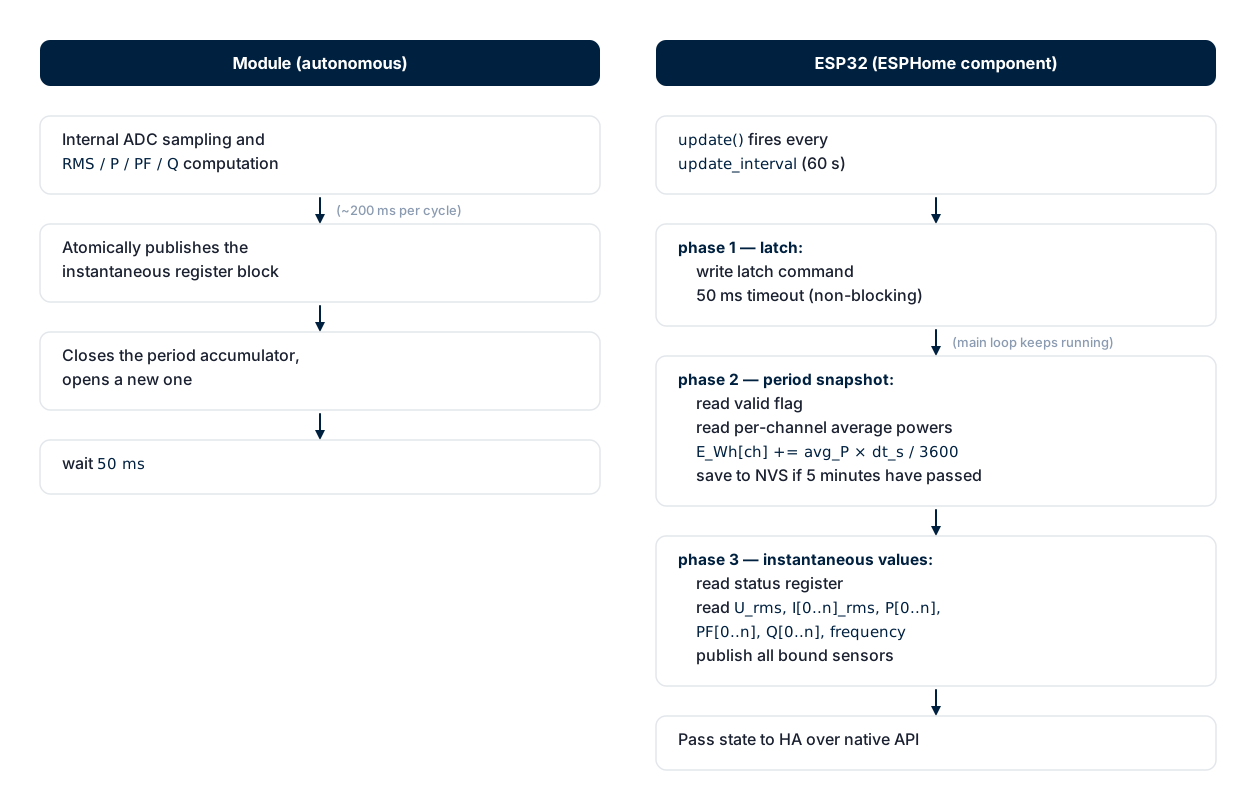
Characteristic timings:
| Event | Cadence |
|---|---|
| Module's internal commit of the instantaneous block | ~200 ms |
update() call |
update_interval (default 60 s) |
| Settle timeout after latch command | 50 ms (non-blocking) |
| Save to NVS | Every 5 minutes |
| Pause between per-byte retries | 5 ms, up to 3 attempts |
| Flash-write window when writing the model | ~700 ms (the module NACKs everything during this time) |
The latch-settle timeout (set_timeout("rbamp_period", 50, ...)) is non-blocking — the cooperative ESPHome scheduler keeps processing WiFi, API and other components during the 50 ms wait. The remaining update() phases (reading the instantaneous registers) run immediately after returning from the latch phase.
The warning [W][component:522]: rbamp took a long time for an operation (XXX ms) on every cycle is expected and harmless. It reflects the wire time for up to 36 I²C transactions (4 bytes for each of 9 float registers) at 50 kHz. See SPEC §B.5.
4. I²C bus settings
The rbamp component inherits the I²C bus configured in the top-level i2c: block. Recommended settings on current firmware:
i2c:
  sda: GPIO21
  scl: GPIO22
  frequency: 50kHz   # 100 kHz causes periodic NACKs; 50 kHz reduces them ~5x
  scan: true         # optional: logs discovered addresses at boot
Bus speed: use 50kHz on current firmware. The module's I²C peripheral periodically NACKs at 100 kHz (~20% of transactions) due to a known behavior in the ESP-IDF i2c_master driver (confirmed in esp-idf issue #9426, marked "Won't Do" by Espressif). The component's three-layer mitigation (retry + sanity + 50 kHz) brings the effective bad-read rate below 1%. Firmware v1.1/v1.3 hardened the module's I²C recovery window, but because the driver-side interaction persists at 100 kHz, 50 kHz is the standing recommendation on ESP-IDF-based masters — including Arduino-ESP32, which wraps the same driver. Non-ESP32 masters (STM32, RP2040, Linux SBC) run this module at 100 kHz (see SPEC §B.5).
Pull-up resistors: 4.7 kΩ to 3.3 V on SDA and SCL recommended. Larger values (10 kΩ) increase rise time and raise the NACK rate at 100 kHz.
Multiple devices: the ESP32 I²C bus supports up to 112 devices on different 7-bit addresses. Use address: and new_address: to assign unique addresses to each module. scan: true in the i2c: block logs every responding address at boot — verify that each module is discovered before enabling period metering.
The full wire-level register map and module command description are in SPEC.md. For a typical YAML-schema user this chapter is sufficient — all registers are hidden behind the declarative interface of the component.
Source & issues: rb-amp/rbamp-esphome · this page in the repo: docs/09_api_reference.md