03 · Real-Time Polling
Real-time polling — reading instantaneous values of U, I, P, PF, flow direction, and related metrics at regular intervals (typically every 200 ms). It is used for:
- Live dashboards (current power, voltage)
- Threshold alarms
- Event detection (load turn-on / turn-off)
- Mains-quality monitoring (frequency, PF)
- Determining current direction — consumption or export (from the sign of P_real)
For tariff energy accumulation (Wh over a period) use the period-latch mechanism described in 04_period_metering.md.
The 200 ms window
What it is
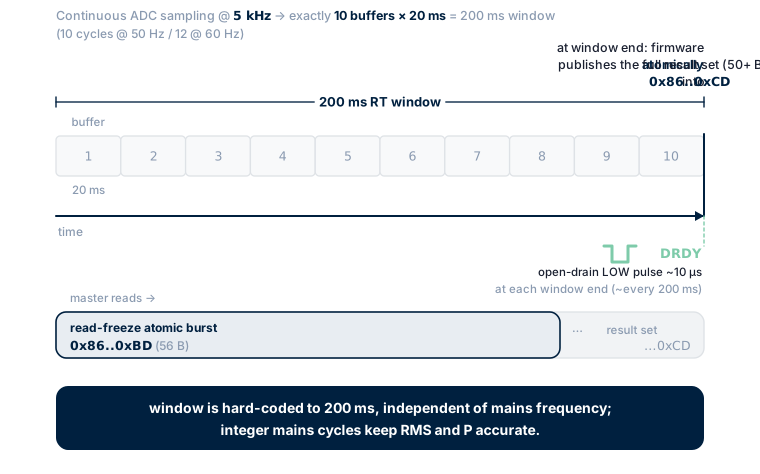
The module continuously samples its ADCs at 5 kHz and produces a result set every ~200 ms:
- RMS of voltage and currents
- Peak values of U and I
- Active power P, computed as
mean(u(t) · i(t))— signed, with the sign indicating flow direction: P > 0— the load consumes from the grid (normal mode)P < 0— the load exports to the grid (solar inverter, regenerative load)- Reactive power Q (computed on a phase-shifted sample stream; the sign distinguishes inductive (+) from capacitive (−))
- Power factor PF = P / S, with S = U_rms × I_rms. The sign of PF matches that of P — an additional indicator of flow direction.
After computing a window, the firmware atomically publishes the entire result set (50+ bytes) into the I2C register block 0x86..0xCD.
Window length is fixed
The window is hard-coded to 200 ms, independent of mains frequency. The firmware collects exactly 10 ADC buffers of 20 ms each (5 kHz sample rate × 100 samples per buffer) and computes the result.
At 50 Hz mains this covers exactly 10 cycles; at 60 Hz, 12 cycles. In both cases the integer number of mains cycles keeps RMS and P accurate.
The register
RT_period_ms(0xCA..0xCD, u32 LE) reports the actual wall-clock duration of the last window — usually close to 200 ms. It is diagnostic only; it does not affect measurement accuracy or the energy calculation (see chapter 04).
When the next window starts
Immediately after the previous one is published. There is no gap between windows — ADC sampling is continuous.
DATA_READY (DRDY) — the ready pin
DRDY is an open-drain output pulled up to 3.3 V on the master side. The firmware drives it LOW for ~10 µs after the RT registers have been refreshed — a hardware signal that says "data is ready to read".
Pulse parameters
- LOW duration: ~10 µs (comfortable for any master with EXTI)
- Frequency: ~5 Hz (one pulse per 200 ms window)
- Output type: open-drain (supports wired-OR in multi-module topologies)
- Semantics: the falling edge guarantees all RT registers are coherent and up to date
When DRDY is not needed
- The master polls slower than 5 Hz (once per second or minute) — data is refreshed five times a second, so any read picks up fresh data.
- A trivial polling loop —
read_rt()can be called any time; you get the latest committed result.
When DRDY is useful
- The master wants to minimise I2C traffic or free up CPU for other tasks (battery-powered systems)
- Precise synchronisation: read the exact moment of measurement completion (useful for high-resolution logs)
- Event detection: react to every window (e.g. instantaneous-power tracking at 200 ms granularity)
Usage (Arduino, one module)
const uint8_t PIN_DRDY = 15;
volatile bool data_ready = false;
void on_drdy_falling() {
  data_ready = true;
}
void setup() {
  Serial.begin(115200);
  Wire.begin();
  pinMode(PIN_DRDY, INPUT_PULLUP);
  attachInterrupt(digitalPinToInterrupt(PIN_DRDY), on_drdy_falling, FALLING);
}
void loop() {
  if (data_ready) {
    data_ready = false;
    float u = rb_read_float_le(0x50, 0x86);
    float i = rb_read_float_le(0x50, 0x8E);
    float p = rb_read_float_le(0x50, 0xA6);
    const char* dir = (p >= 0.0f) ? "consume" : "export";
    Serial.printf("U=%.1f I=%.3f P=%.1f (%s)\n", u, i, p, dir);
  }
}
The sign of P and flow direction
In the RT registers, the sign of active power is the primary indicator of current direction:
| Condition | Meaning |
|---|---|
P_real > 0 |
Load consumes (current flowing in) |
P_real < 0 |
Load exports to the grid (generation) |
P_real ≈ 0 while I_rms > 0 |
Purely reactive load (unloaded transformer, capacitor) |
RMS values of current and voltage are always ≥ 0 (RMS is non-negative by definition). Therefore I_rms cannot be used to determine flow direction — use P_real.
Flow-classification example
void classify_flow(float p) {
  if (p > 10.0f) {
    Serial.println("CONSUMING from grid");
  } else if (p < -10.0f) {
    Serial.println("EXPORTING to grid");
  } else {
    Serial.println("idle / reactive only");
  }
  // ±10 W threshold to avoid chatter near zero
}
On BASIC-tier firmware the tariff accumulator ignores export (see 04_period_metering.md). The RT registers, however, always carry the real-time sign of P — so even on a BASIC SKU the master can detect export events from RT reads, log them, or build a master-side bidirectional accumulator on top of BASIC firmware.
RT register reference
All values are float32 little-endian (4 bytes), read with 4 separate transactions (no auto-increment). Integer fields are marked with their type.
Voltage
| Address | Field | Type | Unit | Description |
|---|---|---|---|---|
0x86 |
U_rms | float32 | V | RMS voltage over the last ~200 ms window |
0x8A |
U_peak | float32 | V | Maximum deviation from mean during the window |
Currents (per channel: 0 = primary, 1/2 on UI2/UI3, more on UI5/UI7)
| Address | Field | Type | Unit |
|---|---|---|---|
0x8E |
I0_rms | float32 | A |
0x92 |
I1_rms | float32 | A |
0x96 |
I2_rms | float32 | A |
0x9A |
I0_peak | float32 | A |
0x9E |
I1_peak | float32 | A |
0xA2 |
I2_peak | float32 | A |
On variants with fewer channels (e.g. UI1), the unused channel registers return
0.0finstead of NACK. Higher-channel-count variants (UI5/UI7) place their additional I_rms / P_real / PF / Q values in registers above0xCF; refer to the SKU datasheet for the extended map.
Power
| Address | Field | Type | Unit | Sign | Description |
|---|---|---|---|---|---|
0xA6 |
P0_real | float32 | W | ± | Active power, channel 0 — P > 0 = consumption, P < 0 = export |
0xAA |
P1_real | float32 | W | ± | Active power, channel 1 (UI2/UI3) |
0xAE |
P2_real | float32 | W | ± | Active power, channel 2 (UI3) |
0xB2 |
PF0 | float32 | – | ± | Power factor, range −1…+1, sign matches P0 |
0xB6 |
PF1 | float32 | – | ± | |
0xBA |
PF2 | float32 | – | ± | |
0xD0 |
Q0_reac | float32 | VAR | ± | Reactive power, channel 0; +inductive, −capacitive (IEEE 1459) |
0xD4 |
Q1_reac | float32 | VAR | ± | |
0xD8 |
Q2_reac | float32 | VAR | ± |
Apparent power S can be derived master-side:
S = U_rms × I_rms. RMS values are always ≥ 0; flow direction lives in the sign of P.Atomicity caveat for Q: the RT block
0x86..0xBD(U/I/P/PF) is delivered under a read-freeze and is guaranteed torn-free in a single burst-read. The Q registers (0xD0..0xDB) are outside that freeze window — if you read U/I/P + Q together in two separate transactions, U/I/P will be from a coherent snapshot but Q may belong to the next RT commit. For inter-quantity coherence at sub-period granularity, either read Q under aCMD_LATCH_PERIODsnapshot (0xC2..0xC9for ch1/ch2 averaged Q is not exposed — use the snapshot block in chapter 11 §4.12) or accept the up-to-200 ms skew between P and Q.
System
| Address | Field | Type | Description |
|---|---|---|---|
0x00 |
STATUS | u8 | bit0 = ready, bit1 = error |
0x02 |
ERROR | u8 | Last error code (0x00 = OK) |
0x03 |
VERSION | u8 | Firmware version |
0x20 |
AC_FREQ | u8 | Mains frequency (Hz), 0 if no zero-cross detected |
0xCE |
DATA_VALID | u8 | bit0 = valid result available since boot |
0xCA |
RT_period_ms | u32 LE | Actual wall-clock duration of the last RT window (ms, diagnostic) |
Polling — single module
Simplest 1 Hz polling loop
void loop() {
  float u = rb_read_float_le(0x50, 0x86);
  float i = rb_read_float_le(0x50, 0x8E);
  float p = rb_read_float_le(0x50, 0xA6);
  float pf = rb_read_float_le(0x50, 0xB2);
  float q = rb_read_float_le(0x50, 0xD0);
  uint8_t freq = rb_read_u8(0x50, 0x20);
  const char* dir = (p >= 0.0f) ? "-> consume" : "<- export ";
  Serial.printf("U=%.1fV  I=%.3fA  P=%.1fW %s  PF=%.3f  Q=%.1fVAR  f=%dHz\n",
                u, i, p, dir, pf, q, freq);
  delay(1000);
}
200 ms polling without DRDY
unsigned long last_read = 0;
void loop() {
  unsigned long now = millis();
  if (now - last_read >= 200) {
    last_read = now;
    float p = rb_read_float_le(0x50, 0xA6);
    Serial.println(p);
  }
}
This yields ~5 samples per second — the same rate at which the firmware refreshes.
Multi-channel current (UI2 / UI3)
On UI2/UI3 variants the master reads currents and powers for all channels:
// UI3: three current channels on one module
void read_ui3(uint8_t addr) {
  float u = rb_read_float_le(addr, 0x86);
  float i0 = rb_read_float_le(addr, 0x8E);
  float i1 = rb_read_float_le(addr, 0x92);
  float i2 = rb_read_float_le(addr, 0x96);
  float p0 = rb_read_float_le(addr, 0xA6);
  float p1 = rb_read_float_le(addr, 0xAA);
  float p2 = rb_read_float_le(addr, 0xAE);
  Serial.printf("U=%.1f  Ch0: %.3fA/%.1fW  Ch1: %.3fA/%.1fW  Ch2: %.3fA/%.1fW\n",
                u, i0, p0, i1, p1, i2, p2);
}
The current channels are independent — each has its own CT clamp with its own coefficient. A UI3 module can monitor, for example, the main feed, the water heater, and the lighting circuit simultaneously on the same phase. The sign of P can differ between channels: mains-input P > 0 (the house consumes from grid) while the solar-output channel shows P < 0 (the inverter exports while feeding the same phase that the house draws from).
All channels share one voltage U
UI variants contain a single voltage sensor — it measures the phase that powers the module. All channels' P values are computed against this shared* U:
P0 = mean(u(t) · i0(t))
P1 = mean(u(t) · i1(t))
P2 = mean(u(t) · i2(t))
This assumes all CT clamps are on conductors of the same phase. For true multi-phase measurement, see the roadmap (rbAmp-U3I3).
Multi-module polling — three strategies
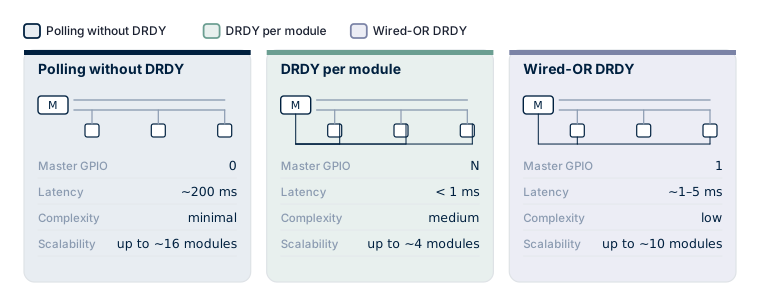
Strategy 1 — round-robin polling (simple)
The master reads the modules in turn, e.g. every 200 ms or every second:
const uint8_t modules[] = {0x50, 0x51, 0x52};
const int N = 3;
int idx = 0;
void loop() {
  uint8_t addr = modules[idx];
  float p = rb_read_float_le(addr, 0xA6);
  Serial.printf("[0x%02X] P=%.1f W\n", addr, p);
  idx = (idx + 1) % N;
  delay(200);
}Pros: minimal code, no extra GPIO required. Cons: master CPU continuously busy; no precise "new window" timestamp.
Strategy 2 — DRDY per module (precise, GPIO-heavy)
Each module's DRDY is wired to its own master GPIO, each with its own EXTI handler:
const uint8_t modules[] = {0x50, 0x51, 0x52};
const uint8_t pins[]    = {15, 16, 17};
volatile bool ready[]   = {false, false, false};
void IRAM_ATTR drdy_0() { ready[0] = true; }
void IRAM_ATTR drdy_1() { ready[1] = true; }
void IRAM_ATTR drdy_2() { ready[2] = true; }
void setup() {
  Wire.begin();
  void (*isr_arr[])() = {drdy_0, drdy_1, drdy_2};
  for (int i = 0; i < 3; i++) {
    pinMode(pins[i], INPUT_PULLUP);
    attachInterrupt(digitalPinToInterrupt(pins[i]), isr_arr[i], FALLING);
  }
}
void loop() {
  for (int i = 0; i < 3; i++) {
    if (ready[i]) {
      ready[i] = false;
      float p = rb_read_float_le(modules[i], 0xA6);
      Serial.printf("[%d] P=%.1f W\n", i, p);
    }
  }
}Pros: precise synchronisation, minimal read latency. Cons: one GPIO + EXTI per module; does not scale beyond ~4 modules.
Strategy 3 — wired-OR DRDY (compact)
All DRDY pins (open-drain) are joined on a single wire. The master detects the falling edge of any module and reads all modules:
rbAmp #1 DRDY ──┐
rbAmp #2 DRDY ──┼──┬─[10K]── +3.3V
rbAmp #3 DRDY ──┘  │
                   ▼
Master GPIO IN (EXTI falling)const uint8_t modules[] = {0x50, 0x51, 0x52};
const uint8_t PIN_DRDY = 15;
volatile bool any_ready = false;
void IRAM_ATTR drdy() { any_ready = true; }
void setup() {
Wire.begin();
pinMode(PIN_DRDY, INPUT_PULLUP);
attachInterrupt(digitalPinToInterrupt(PIN_DRDY), drdy, FALLING);
}
void loop() {
if (any_ready) {
any_ready = false;
for (int i = 0; i < 3; i++) {
float p = rb_read_float_le(modules[i], 0xA6);
Serial.printf("[0x%02X] P=%.1f W\n", modules[i], p);
}
}
}Pros: one GPIO + EXTI for any number of modules; wire-economical. Cons: the master does not know which module asserted the line — it must read all of them. Slightly-offset module periods (each module has its own crystal) produce "double" triggers (one module ready, another a millisecond later). Harmless — just read all modules.
Trade-off table
| Approach | Master GPIO | Latency | Complexity | Scalability |
|---|---|---|---|---|
| Polling without DRDY | 0 | ~200 ms | minimal | up to ~16 modules |
| DRDY per module | N | < 1 ms | medium | up to ~4 modules |
| Wired-OR DRDY | 1 | ~1–5 ms | low | up to ~10 modules |
Recommendation
- 1–3 modules, low latency required → DRDY per module
- 3–10 modules, GPIO budget matters → wired-OR DRDY
- Any number, latency does not matter → simple polling
I-only variants (no voltage sensor)
On I1/I2/I3 (and higher-channel I*-only variants), without a voltage sensor:
| Register | Returns |
|---|---|
U_rms (0x86) |
0.0f |
U_peak (0x8A) |
0.0f |
I*_rms, I*_peak |
Real values |
P*_real (0xA6, 0xAA, 0xAE) |
0.0f (no U → no P) |
PF*, Q* |
0.0f |
AC_FREQ (0x20) |
Real value (50 or 60). Zero-cross detection comes from a dedicated mains-ZC pin independent of the voltage front-end and is available on all variants, including I-only. |
ZC_OFFSET (0x4E) |
0xFFFF. This register is the phase offset between the GC latch instant and the next voltage zero-cross, used for U/I phase compensation — meaningful only when a voltage signal is being measured. On I-only variants it is firmware-gated to 0xFFFF (no voltage measurement). |
Without P there is no information about current direction — I_rms is always ≥ 0 and does not show which way current flows.
I-only variants are intended for:
- Masters that provide their own voltage source and compute P themselves (e.g. an ESP32 with a built-in ZMPT module plus an rbAmp-I3 for three loads)
- Current-only applications: load presence detection, overcurrent protection, balancing of resistive heating elements
RT register quick reference
0x00 STATUS (u8)         — bit0=ready, bit1=error
0x02 ERROR (u8)          — last error code
0x03 VERSION (u8)        — protocol version (0x04 = v1.3)
0x05 CT_MODEL (u8, RW)   — staging only; bind via CMD_SET_CT_MODEL_CHn (see ch 02)
0x20 AC_FREQ (u8)        — mains frequency, Hz (all variants — ZC-sourced from a dedicated pin)
0x30 I2C_ADDRESS (u8 RW) — slave address; change via two-phase commit (see ch 02)
0x86 U_rms (f32)         — V
0x8A U_peak (f32)        — V
0x8E I0_rms (f32)        — A
0x92 I1_rms (f32)        — A
0x96 I2_rms (f32)        — A
0x9A I0_peak (f32)       — A
0x9E I1_peak (f32)       — A
0xA2 I2_peak (f32)       — A
0xA6 P0_real (f32, ±)    — W  (sign: + consume, − export)
0xAA P1_real (f32, ±)    — W
0xAE P2_real (f32, ±)    — W
0xB2 PF0 (f32, ±)        — −1..+1
0xB6 PF1 (f32, ±)        — −1..+1
0xBA PF2 (f32, ±)        — −1..+1
0xCA RT_period_ms (u32)  — diagnostic, actual window duration
0xCE DATA_VALID (u8)     — bit0 = valid after boot
0xD0 Q0_reac (f32, ±)    — VAR (sign: + inductive, − capacitive)
0xD4 Q1_reac (f32, ±)    — VAR
0xD8 Q2_reac (f32, ±)    — VAR
Next
- 04_period_metering.md — atomic period latch for tariff accumulation
- 05_troubleshooting.md — what to do if values look wrong