01 · Hardware Connection
This chapter describes the physical connection of rbAmp to a master device and the power requirements. The module arrives ready to operate: everything on its mains side is wired up and isolated inside the enclosure. The user works only with the low-voltage (LV) side — four wires for I2C, an optional DRDY line, and (for SKUs with an external CT) a 3.5 mm jack for the clamp.
LV-side pinout
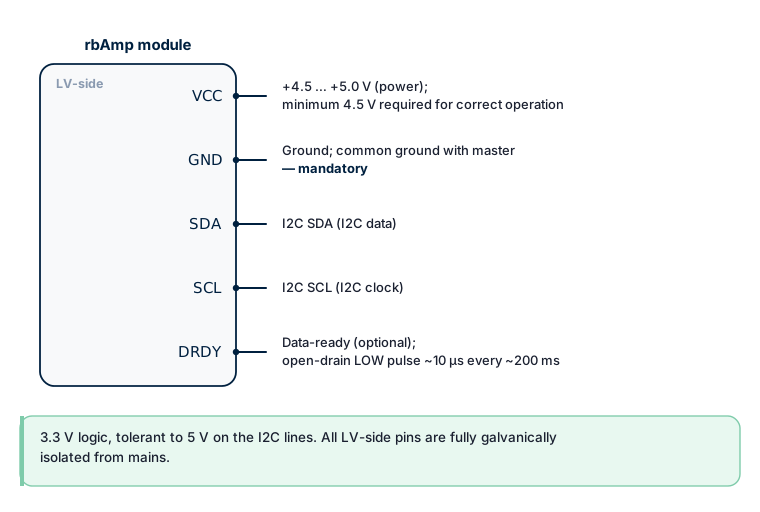
The module runs on 3.3 V logic and is tolerant to 5 V logic on the I2C lines. All LV-side pins are fully galvanically isolated from mains.
| rbAmp pin | Signal | Function |
|---|---|---|
VCC |
+4.5 … +5.0 V (power) | Module power; minimum 4.5 V required for correct operation |
GND |
Ground | Common ground with master — mandatory |
SDA |
I2C SDA | I2C data |
SCL |
I2C SCL | I2C clock |
DRDY |
Data-ready (optional) | Open-drain LOW pulse ~10 µs every ~200 ms |
I2C pull-ups — installed on the board
Important: each rbAmp module has built-in 4.7 kΩ pull-up resistors on SDA and SCL to 3.3 V. For a single-module bus, no external pull-ups are required — connect the master directly.
When to disable the built-in pull-ups
If several rbAmp modules (or other I2C devices with their own pull-ups) are on the bus, their parallel combination yields too low an effective resistance, which:
- Increases bus power consumption
- Can exceed the maximum sink current of the I2C-master output stage (typically ≤ 3 mA on 3.3 V logic)
- Adds capacitive load on long buses, while contributing little to noise immunity
Solution: each module has solder-jumper cuts on the bottom of the PCB next to the pull-up resistors. The silkscreen reads Pull-Up. Cut the trace with a sharp blade to disconnect the pull-up:
- Leave the pull-ups enabled on only one module on the bus (or relocate them to a single point near the master).
- Cut the jumpers on the remaining modules.
- If the master board already provides bus pull-ups, cut the jumpers on all rbAmp modules.
Rule of thumb
| rbAmp modules on bus | Pull-ups |
|---|---|
| 1 | Leave alone (built-in 4.7 kΩ work) |
| 2 | Leave on one module, cut on the other |
| 3+ | Cut on all modules, install one external 2.2…4.7 kΩ pair near the master |
In doubt: measure the resistance between SDA and VCC with all devices unpowered. For a single-module bus the typical value is ~4.7 kΩ (one built-in pull-up); on a multi-module bus the parallel combination drops to the 1.5–4.7 kΩ range depending on how many built-in pull-ups remain active. Anything below ~1 kΩ means too many active pull-ups in parallel — cut the built-in pull-ups on all but one module.
Power
VCC parameters
- Nominal voltage: 5 V DC
- Acceptable range: 4.5 … 5.5 V
- Current draw: ~15 mA typical, ~25 mA peak during flash write
- Ripple: < 50 mV peak-to-peak (for ADC accuracy)
I2C voltage compatibility
- SDA/SCL run on 3.3 V logic (the built-in pull-ups tie them to 3.3 V).
- The lines are 5 V-tolerant, so a 5 V master (Arduino UNO / Nano) reads HIGH (~3.3 V) correctly and can drive the bus.
- For 5 V bus levels, disable the built-in pull-ups and add external pull-ups to +5 V on the master side.
Power-on behavior
- Cold start: ~250 ms to the first valid measurement result.
- After RESET (software or brown-out): ~250 ms to recover.
- Before the first valid result, registers read 0 and
DATA_VALID(0xCE) is 0.
Isolation
The module contains a galvanic isolation barrier between the mains side (CT clamp, voltage divider) and the LV side (I2C). Consequently:
- The module's GND is not connected to mains phase or neutral.
- Connecting the LV side to a 5 V master is safe — no short-circuit risk through ground.
Do not open the enclosure — it will void factory calibration.
I2C bus
Parameters
- Default address:
0x50(7-bit) - Address range:
0x08..0x77(reprovisionable via two-phase commit, see 02_initialization.md) - Speed: 50 kHz recommended (lowest NACK rate observed across host stacks). 100 kHz workable with application-level retry. 400 kHz is not validated for v1.3.
- READ auto-increment: YES — burst-read supported (multi-byte registers, V03 RT block, DIGEST window).
- WRITE auto-increment: NO — every byte written needs an explicit register address, including multi-byte fields (write low byte, then high byte separately).
- Clock-stretching: not used by the module as a flow-control mechanism. The master should observe an inter-transaction gap (
tBUF) of ≥ 100 µs.
Bus length
I2C is, by default, a short bus (~30 cm). The following topologies are validated for rbAmp:
| Cable topology | Max length | Speed |
|---|---|---|
| Standard JST / 4-wire flat cable | up to 0.3 m | 100 kHz |
| Twisted pair UTP (cat-5/5e/6) — SDA+GND and SCL+GND in separate pairs | up to 1 m | 100 kHz |
| Twisted pair UTP + I2C buffer (PCA9515 / TCA9617) | up to 3 m | 100 kHz |
| Differential bus (PCA9615 / LTC4332) | up to 100 m | 100 kHz |
For runs longer than 0.3 m, twisted pair is required: SDA and SCL must be in separate pairs, each with its own ground (for example, blue + blue-white for SDA, green + green-white for SCL). Putting SDA and SCL in the same pair causes cross-coupling that distorts edges.
Multi-module bus
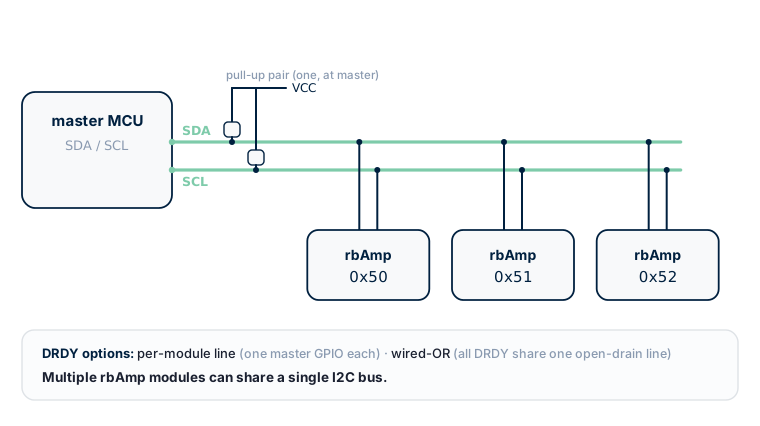
Multiple rbAmp modules can share a single I2C bus:
- Module count: up to ~16 (limited by total bus capacitance — ≤ 400 pF at 100 kHz)
- Addresses: every module has its own 7-bit address. All modules ship from the factory on
0x50; readdress them one at a time before connecting in parallel (see 02_initialization.md → Address change). - Pull-ups: follow the rule above — cut the built-in pull-ups on all but one module, or relocate them to a single point.
Sensor connections (mains side)
Voltage sensor (UI* variants)
The PCB exposes L (line / phase) and N (neutral) terminals. Polarity matters for the sign of active power:
- Correct wiring (L → L, N → N):
P > 0means consumption (current flowing into the load from the grid),P < 0means export to the grid (generation). - Swapped wiring (L and N exchanged): the sign of P is inverted — consumption is reported as negative power.
Correct polarity is critical for:
- Accurate BASIC-tier accounting (BASIC counts only
max(P, 0); swapped polarity zeros out the energy total). - Correct separation of consumption and generation on STANDARD and PRO tiers.
Quick check: with a purely resistive load (electric kettle, heater, incandescent bulb),
P > 0andPF ≈ 1.0. If P is negative while the load is consuming, swap L and N on the PCB.
Current sensor — CT and SCT-013 (for SKUs with external CT)
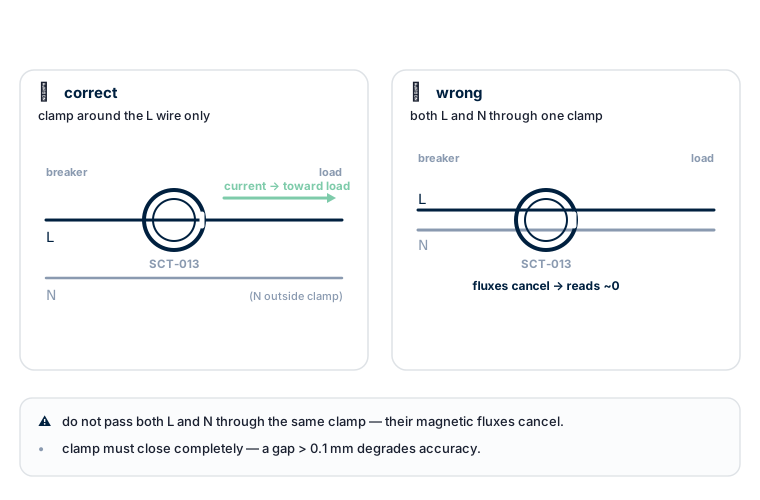
External CT clamps connect to the module through a 3.5 mm jack. The connector is keyed for correct polarity out of the box; no wiring decisions are needed.
The clamp body bears an arrow indicating the direction of energy flow for the "normal" orientation:
┌─────────┐
      │  SCT    │  → (arrow)
      │  CLIP   │
      └─────────┘
           │
       clamps around the L wire
       with the arrow pointing
       toward the load (consumer)
Rules:
- Clamp the sensor around the line (L) wire going to the consumer.
- The arrow on the clamp must point in the direction of current toward the load (from breaker panel to load).
- The clamp must close completely — no gap between the two halves of the magnetic core. A gap > 0.1 mm sharply increases magnetic reluctance and degrades accuracy.
⚠️ Warning: do not pass both L and N through the same clamp. Their magnetic fluxes are equal and opposite, so they cancel — the sensor reads near zero current even under real load.
Channel markings on the PCB
Each jack on the PCB is labeled with the channel name (I0, I1, I2, …) and a color marker. SCT-013 cables are electrically symmetric — orientation is established by the arrow on the clamp and its placement on the wire, not by which end of the cable goes into the jack.
Polarity and the sign of P
- Arrow in the correct direction + correct L/N polarity →
P > 0for consumption,P < 0for export. - Clamp installed reversed (arrow against current direction) → the sign of P is inverted.
DATA_READY (DRDY)
Optional pin for optimized polling. If your application is happy polling every 200 ms, you can leave DRDY disconnected.
Electrical parameters
- Output type: open-drain (no active pull-up to VCC)
- Idle level: HIGH (requires a pull-up on the master side — either an internal MCU pull-up or an external resistor; recommended 10 kΩ to 3.3 V)
- Ready pulse: LOW for ~10 µs, after RT registers (
0x86..0xCF) have been refreshed - Pulse frequency: ~5 Hz (one pulse per ~200 ms RT window)
Semantics
The falling edge of DRDY guarantees that all RT registers are coherent and freshly published (the firmware updates them atomically inside an ISR before lowering the pin). The master can read 0x86..0xCD immediately on the falling edge with no risk of a split sample.
Master-side usage
- EXTI / GPIO interrupt on the falling edge — wakes the master and triggers a read.
- Pull-up 10 kΩ to 3.3 V on the master side.
- Multiple module DRDYs can be combined into a wired-OR (see 03_realtime_polling.md → Multi-module DRDY).
Applicability
- DRDY fires only on RT updates (every 200 ms).
- DRDY does not fire on period snapshots (period snapshots are updated by the latch command which the master triggers — so the master already knows when to read).
- For slow-polling masters (every 1 s or 60 s), DRDY can be ignored.
Reference wiring example (ESP32, single module)
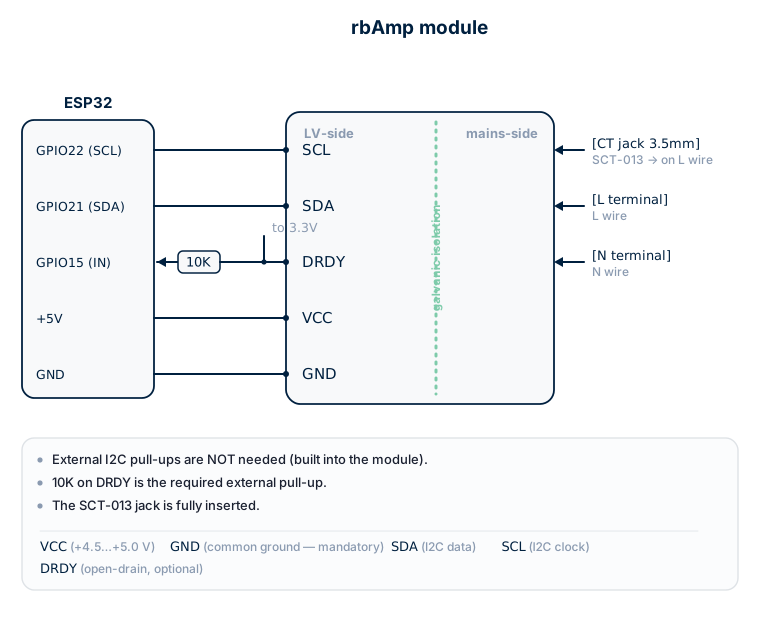
rbAmp module
                              +----------------------+
                              |   LV-side            |  mains-side
ESP32 GPIO22 (SCL) -----------| SCL                  |◄[CT jack 3.5mm]── SCT-013 → on L wire
ESP32 GPIO21 (SDA) -----------| SDA                  |◄[L terminal]──── L wire
ESP32 GPIO15 (IN)  ◄──[10K]──┐| DRDY (open-drain)    |◄[N terminal]──── N wire
                       to 3.3V|                      |
ESP32 +5V    -----------------| VCC                  |
ESP32 GND    -----------------| GND                  |
                              +----------------------+
In this configuration:
 - External I2C pull-ups are NOT needed (built into the module).
 - 10K on DRDY is the required external pull-up.
 - The SCT-013 jack is fully inserted.
 - The clamp is fully closed on the L wire, arrow pointing toward the load.
Roadmap for multi-phase models
For future SKUs (rbAmp-U2I2 US split-phase, rbAmp-U3I3 three-phase) the LV-side pinout remains identical (VCC / GND / SDA / SCL / DRDY). Only the mains side changes — more L terminals and more CT jacks. Existing master drivers will not need to be rewritten for the base register set; new registers are added for the additional U1/U2/U3 channels.
Next
- 02_initialization.md — first connection, smoke test, address change
- 05_troubleshooting.md → CT clamp & polarity — what to do if the sign of P is wrong or I_rms is unstable